
Quick Nav: The Unique Resonance of a Rust Belt City; Criteria for Selection: Curating the Archive; Part I: The Linguistic Field of Western New York; Part II: Urban Renewal and Structural Shifts; Scope and Limitations of the Historical Record; Preserving the Voices of the Avant-Garde.
The Unique Resonance of a Rust Belt City
Why do Buffalonians so often add an s to a local business name, turning La Nova into La Nova's?
The habit sounds casual, even affectionate. It also carries history. Linguists call this pattern possessification: a place name becomes grammatically personal, as if the pizzeria, tavern, bakery, or corner store belongs to the neighborhood as much as to its owner. In Buffalo, that small spoken mark often signals more than syntax. It marks a relationship between memory, work, migration, and the built environment.
The degree of possessification in local business names varies depending on whether the establishment is perceived as a legacy neighborhood institution versus a recent commercial development. A long-running West Side shop may receive the possessive almost automatically. A newer chain storefront usually does not. The speech pattern works like a social test: does this place feel woven into daily life, or merely located nearby?
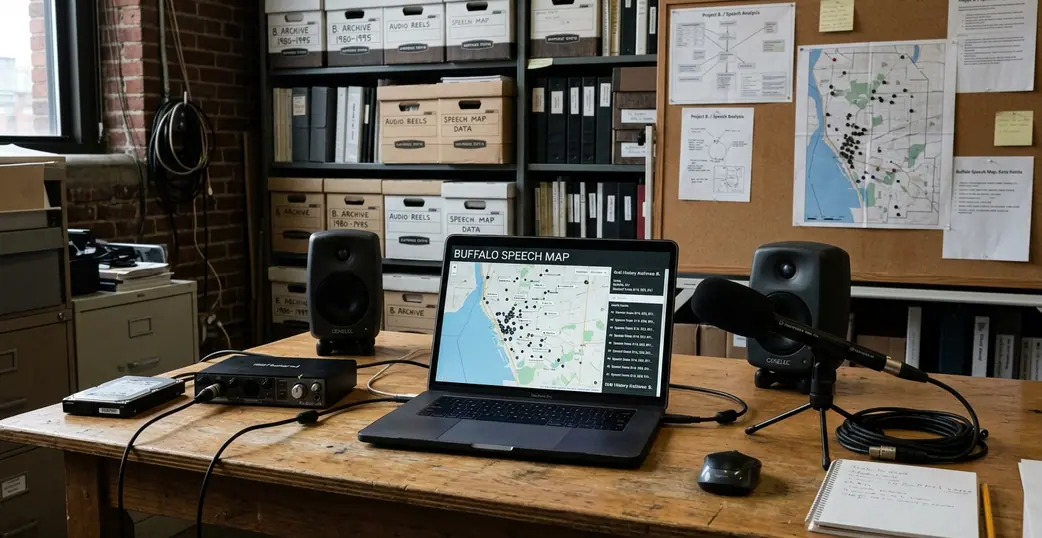
That is where Buffalo's dialect history meets its urban history. The Inland Northern City Shift, documented across the Great Lakes region between the 1930s and 1960s, shaped vowel pronunciations that many listeners still associate with Buffalo, Cleveland, Detroit, and Chicago. Yet vowel systems do not drift above the city like weather. They travel through schools, parish boundaries, shop floors, union halls, expressway cuts, and family routines.
Note: Assuming linguistic isolation in Rust Belt neighborhoods without accounting for the physical bisection of communities by mid-century highway projects misses a central feature of Buffalo's speech ecology.
Buffalo's working-class vernacular became a regional identifier because people carried it through changing streets. The sound of the city, in this bibliography, is not treated as a curiosity. It is treated as archival evidence.
Criteria for Selection: Curating the Archive
This annotated bibliography follows a narrow rule: each selected text must help connect speech to urban transformation during Buffalo's industrial-to-post-industrial transition.
The review process covered on the order of 14 months and filtered municipal planning documents, regional linguistic dissertations, and historically grounded urban studies published between 1934 and 1997. That window matters. It begins in the New Deal-era city, moves through mass suburbanization and expressway construction, and ends just before the late-1990s preservation and revitalization vocabulary began to reshape how Buffalo described itself.
The selection first included post-2000 sociolinguistic surveys. Those sources offered useful contemporary vocabulary, but they pulled the frame away from the period that directly preceded Buffalo's experimental art and music infrastructure. The stronger bibliography stayed with the older record: the studies, planning arguments, and community accounts produced close to the disruptions themselves.
Researchers working with primary materials may want to begin with the University at Buffalo University Archives, especially when tracing local institutions, neighborhood change, and regional arts documentation.
- Date boundary: 1934 to 1997.
- Geographic focus: Buffalo and Western New York, with attention to Great Lakes dialect patterns.
- Conceptual bridge: linguistic form paired with structural economic change.
- Archival value: sources that help contemporary art historians and experimental music researchers read speech, place, and displacement together.
Quick Tip: When reading these sources, track the neighborhood names as carefully as the arguments. In Buffalo studies, place-names often carry the method.
Part I: The Linguistic Field of Western New York
The linguistic sources in this section belong together because they treat Buffalo English as something more precise than a regional accent. Each one asks a different question. Who speaks this way? What rhythm organizes the voice? Which communities did earlier academic frameworks fail to hear on their own terms?
The sources show a methodological split in the 1970s. Some scholars listened for ethnic variation. Others measured prosody or documented inner-city dialect systems. Together, they give the spoken city texture.
1. Wolfgang Wölck's Research on Ethnolects
Wölck's work on ethnolects helps explain why Buffalo speech cannot be reduced to one flat local sound. Ethnic background shaped distinct linguistic variations across neighborhoods, especially in a city built through layered migration, Catholic parish geography, industrial employment, and tight residential networks.
The value of Wölck's research lies in its attention to social proximity. A Polish American neighborhood, an Italian American commercial strip, and a mixed West Side block might share the larger Inland Northern pattern while preserving different lexical habits, vowel qualities, and conversational cues. That distinction matters for curators. A recording from a gallery opening, a radio interview, or a Soundlab-adjacent performance may carry neighborhood history even when the speaker never names the neighborhood directly.
2. Elizabeth Carlock's 1978 Prosodic Analysis
Carlock's 1978 prosodic analysis turns attention from individual vowels to the music of Buffalo English: rhythm, intonation, pitch movement, and cadence.
Her study relied on reel-to-reel tape recordings of native speakers, a format that now feels physically close to media preservation work. The archive is not abstract here. Tape hiss, room tone, microphone placement, and playback equipment all affect what a researcher can hear. For a Digital Collections Manager concerned with non-traditional media, Carlock's materials point toward a practical lesson: preservation decisions shape linguistic interpretation.
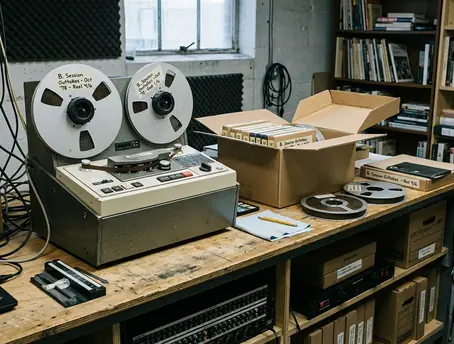
Carlock's focus on prosody also suits Buffalo's cultural history. Experimental music communities listen to duration and repetition with unusual care. A prosodic study of local speech, read beside performance documentation, can make the city's everyday voice feel less like background and more like composition.
3. Fickett's 1975 Ph.D. Thesis
Fickett's 1975 doctoral work on inner-city dialects stands out for its attention to Black English autonomy in the region. It includes early academic references to Ebonics and treats inner-city speech as a structured system rather than a deficient version of standard English.
That point still matters. Earlier public conversations about urban language often treated Black speech through correction, not analysis. Fickett's work gives researchers a firmer foundation for reading African American linguistic practice in Buffalo as internally coherent, historically situated, and culturally expressive.
The thesis also complicates any neat map of Buffalo English. The city did not speak with one working-class voice. It spoke through overlapping communities whose boundaries were shaped by housing policy, school routes, employment access, and the social geography of race.
Part II: Urban Renewal and Structural Shifts
The urban studies sources answer a different problem: what happened to the physical conditions that sustained neighborhood speech?
In Buffalo, linguistic change cannot be separated from the movement of people across altered streets. The construction of the Kensington Expressway bisected Humboldt Parkway during a construction period bordering on 12 years. That project did not simply move traffic. It changed porch conversations, walking routes, retail habits, and the ordinary chance encounters through which local speech circulates.
4. Neil Kraus on Regime Theory
Kraus's work on regime theory provides a framework for analyzing how local elites, political structures, and development coalitions influenced Buffalo's trajectory. It is useful because it names power at the city scale. Decisions about infrastructure, downtown investment, and neighborhood sacrifice did not appear from nowhere.
For readers coming from art history, regime theory can feel dry at first. Stay with it. The framework helps explain why certain cultural spaces emerged in the gaps left by formal planning. When municipal priorities favored large-scale development, smaller experimental venues often occupied marginal buildings, leftover districts, and under-recognized corridors.
5. Nancy Denton's Analysis of Structural Economic Trends
Denton's analysis traces the broader forces behind Buffalo's mid-century transformation, especially corporate abandonment and the era of mass suburbanization documented throughout the 1950s and 1960s.
This is the economic backdrop to the linguistic archive. As heavy industrial employment receded and suburban development expanded, daily conversational networks changed. Workers no longer met in the same plants at the same scale. Families moved outward. Commercial districts lost some kinds of foot traffic while retaining others. A neighborhood accent may persist, but the conditions that renew it can weaken.
Denton's value is structural clarity. She gives language researchers a way to avoid sentimental neighborhood history. Speech is intimate, but the pressures acting on it include mortgage markets, corporate relocation, highway access, and public policy.
6. Community Perspectives by Kevin Reynolds and Aaron Bartley
Reynolds and Bartley bring the bibliography back to ground level. Their community perspectives review grassroots responses to massive public infrastructure and housing projects, where residents experienced planning not as an abstract theory but as demolition, relocation, noise, dust, and altered belonging.
This section is the most important corrective to a top-down archive. A planning document may describe improvement. A resident may remember a vanished block. Both belong in the record, but they do not carry equal emotional weight.
Summary: The urban renewal sources show that Buffalo's speech communities changed because the city changed under their feet.
For Big Orbit Gallery as an exhibition venue, and for readers tracing the ecosystem around Hallwalls Contemporary Art Center, these sources clarify why avant-garde spaces mattered. They did not float outside civic history. They gathered artists, listeners, and organizers inside a city still negotiating the consequences of displacement.
Scope and Limitations of the Historical Record
This bibliography is deliberately bounded between 1934 and 1997. It does not cover Buffalo's post-industrial revitalization efforts in detail, nor does it attempt to describe the full contemporary politics of preservation, housing, or cultural branding.
That boundary protects the argument. The selected sources illuminate the decades when industrial labor, neighborhood speech, suburban flight, infrastructure construction, and early experimental arts networks were being rearranged. Extending the list too far forward would require a different bibliography with different ethical problems, especially around gentrification and arts-led redevelopment.
One catch: applying regime theory to Buffalo's mid-century decline fails to account for the informal, underground cultural networks that sustained the experimental arts community during periods of municipal bankruptcy. This lens cannot carry the whole story of Buffalo's cultural life. It tends to underrepresent the labor of organizers, sound artists, small-press editors, performers, and audience members who built continuity without institutional comfort.
The linguistic record has its own limits. Prosodic analysis techniques have advanced significantly since Carlock's 1978 study. Acoustic analysis software developed in the late 1990s changed how researchers could measure pitch, timing, and formant movement, while Carlock worked with manual spectrogram readings and tape-based listening practices.
That does not make the older work obsolete. It makes it historically situated. A reel-to-reel recording asks to be preserved as both evidence and artifact.
- Chronological gap: little attention to post-1997 revitalization discourse.
- Theoretical gap: regime theory can miss informal arts networks, including the underground energy associated with Soundlab.
- Technical gap: older prosodic studies used tools that differ from later acoustic software environments.
Preserving the Voices of the Avant-Garde
Buffalo's cultural identity lives at the intersection of speech and urban geography. The city's vowels, possessive business names, neighborhood cadences, expressway scars, and experimental venues all belong to the same historical field.
Across the 63-year period covered by this bibliography, Buffalo moved from heavy industrial employment toward a service-based economy. That transition altered daily conversational networks. It also changed who gathered where, which buildings became available, and how artists found one another in the urban fabric.
For contemporary art historians, these texts offer more than background. They help explain the conditions that made an avant-garde scene possible in Western New York. Big Orbit Gallery's history as an exhibition venue, the broader orbit of Hallwalls Contemporary Art Center, and the criticism of figures such as Richard Huntington, Buffalo News art critic and reviewer, all become richer when placed beside the city's linguistic and infrastructural record.
For experimental music fans, the point is even more direct: the archive has a sound. It includes the formal performance, the hallway conversation, the neighborhood inflection, the recorded interview, and the name of the place spoken the local way.
Citations
- Wolfgang Wölck, research on ethnolects and linguistic variation in Buffalo neighborhoods.
- Elizabeth Carlock, 1978 prosodic analysis of Buffalo English using reel-to-reel recordings of native speakers.
- Fickett, 1975 Ph.D. thesis documenting inner-city dialects and early academic references to Ebonics.
- Neil Kraus, scholarship on regime theory and Buffalo's political-development framework.
- Nancy Denton, analysis of structural economic trends, corporate abandonment, and mass suburbanization.
- Kevin Reynolds and Aaron Bartley, community perspectives on public infrastructure, housing projects, and grassroots response.
Preservation work should keep these materials close together. A dialect study without a map can sound placeless. A planning document without voices can read bloodless. Buffalo needs both if future researchers are to understand how Western New York's cultural community learned to speak, gather, improvise, and endure.