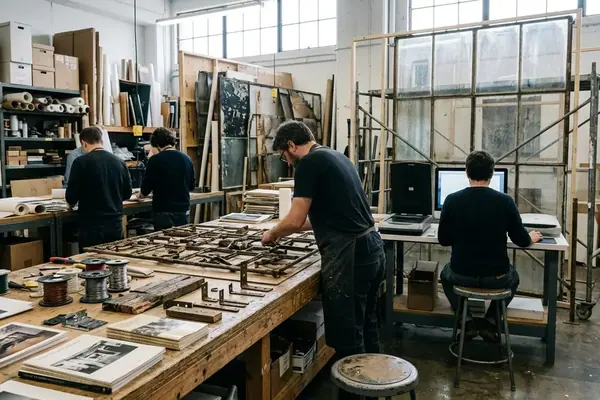
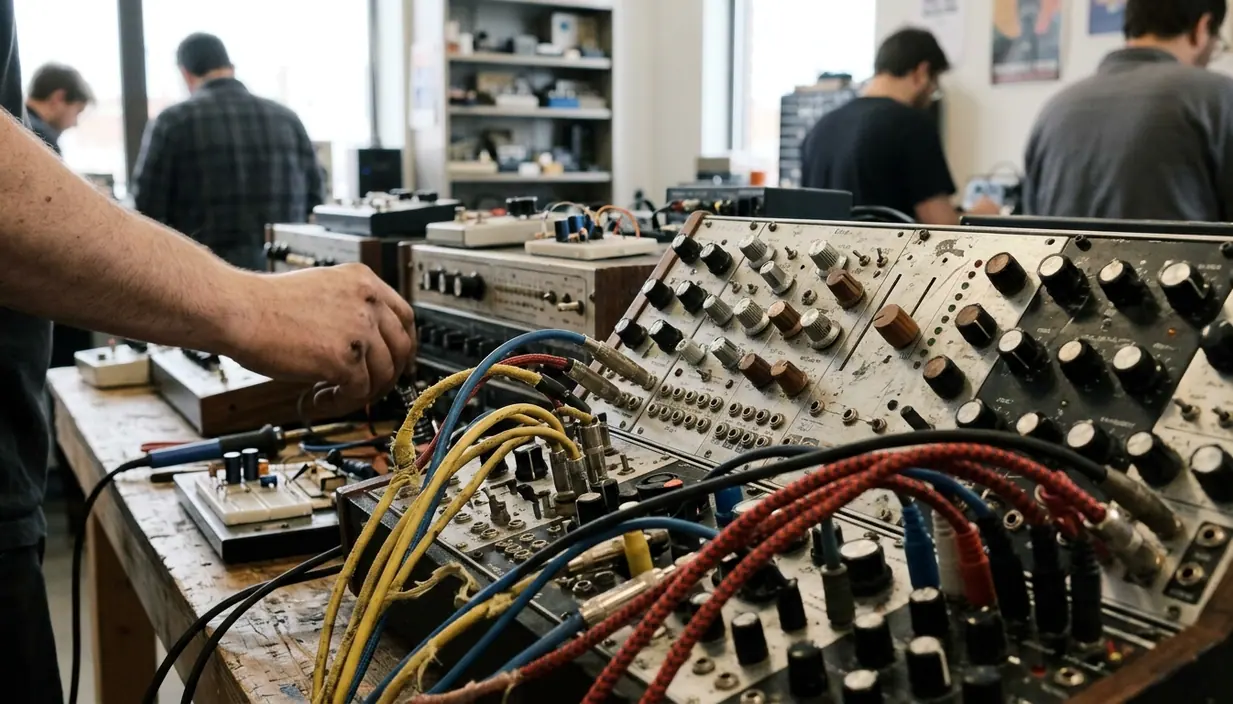
The Rust Belt Resonance: Finding Art in the Noise
How does a city defined by shuttered grain elevators and the slow contraction of heavy manufacturing produce one of North America's most uncompromising avant-garde music communities? Buffalo offers no obvious answer, and that ambiguity is precisely the point.
The sound of Western New York at the close of the twentieth century was not silence. It was drone. The low industrial hum of plants running into the small hours, the rumble of freight, the wet acoustic blanket of humid air rolling off Lake Erie—these formed a baseline that classical halls were built to exclude. Soundlab did the opposite.
Where a traditional venue treats ambient noise as contamination, the curators who shaped Soundlab treated it as raw material. The decision was deliberate and, for a time, contested. Early on, the programming committee debated whether to seal the industrial sounds of the city out entirely or to fold them into the work itself. They chose integration, leaving the loading dock doors slightly ajar during early summer performances so that the building breathed alongside the music.
That choice extended to scheduling. Late-night sets frequently began after around 11:00 PM, timed to coincide with the shift changes at nearby manufacturing plants—a way of guaranteeing a specific baseline of urban drone beneath whatever happened on the floor. Summer programming clustered from late May through mid-July, capitalizing on the dense, humid acoustics that the lake pushes across the city in those weeks.
This was not noise as nuisance. It was noise as foundation.
A City Without a Stage: The Pre-Soundlab Era
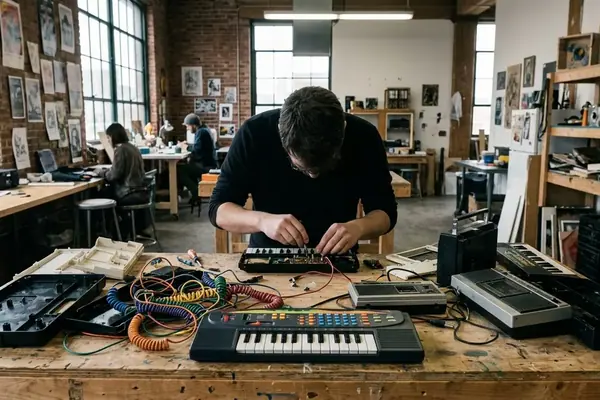
Before there was a room, there was a problem. Buffalo had musicians working in harsh noise, free improvisation, and electro-acoustic composition, but it had nowhere built to hold them.
The commercial circuit had no use for work that refused to sell drinks on a predictable schedule. In the late 1990s, experimental acts were typically relegated to brief interstitial slots between traditional punk bands at local dive bars—filler material between the acts that actually drew a crowd. A composer who needed on the order of forty minutes of patient dynamic build was handed a truncated set and a bar tab to justify.
So organizers improvised the infrastructure itself. They ran a decentralized booking model, scouting abandoned commercial basements on a month-to-month basis, moving whenever a lease evaporated or a landlord lost patience. It was scrappy and it was unsustainable. The sheer volume of blown PA systems eventually forced the question of a permanent home.
The basements failed acoustically, not just logistically. Ceiling heights in those temporary spaces rarely exceeded about 8 feet, which strangled the dispersion of high-frequency sound waves and flattened any sense of spatial depth. Worse, the rooms were never treated. Attempting to play delicate electro-acoustic sets in untreated basement venues resulted in total frequency masking from overhead HVAC units—the very quiet passages that defined the genre simply vanished under the wash of a furnace fan.
Local art historians and working musicians grew openly frustrated. What they wanted was not a club. It was a testing ground.
Architecting the Avant-Garde: Soundlab's Curatorial Vision
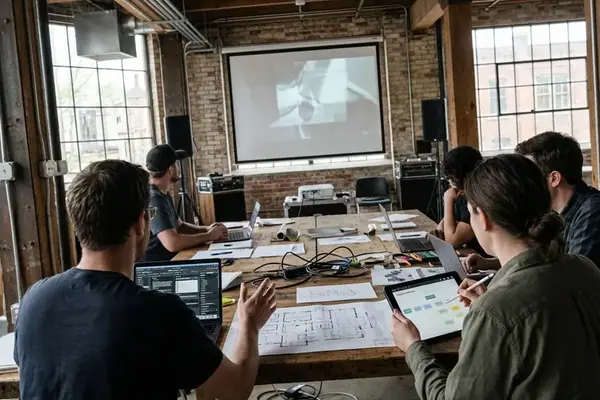
The solution emerged as an extension of the Big Orbit Gallery ethos: rigorous, curated, and unafraid of the difficult. Soundlab took the seriousness of a white-cube exhibition venue and married it to the visceral immediacy of a subterranean club. Neither identity dominated. The room held both.
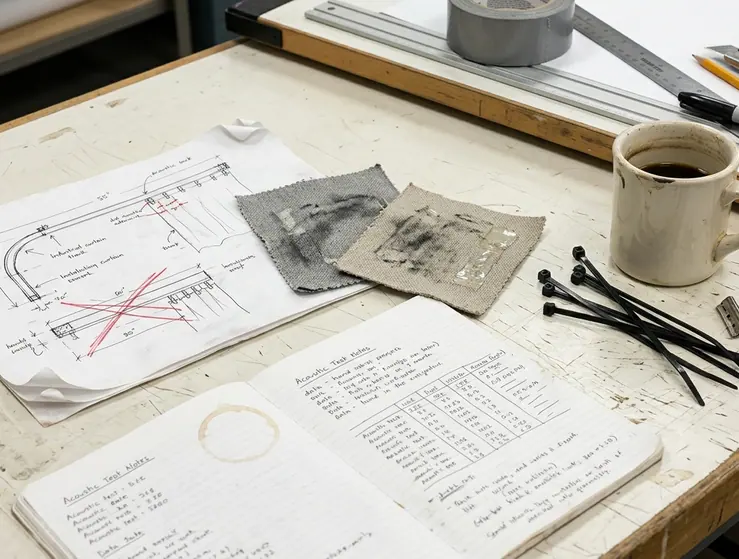
That dual personality demanded a flexible architecture. The committee rejected fixed seating and permanent stages in favor of modular acoustic baffling—heavy velvet curtains hung on industrial tracks that could be drawn open for a sprawling noise wall or pulled tight to deaden a room for a whisper-quiet improvisation. The space reconfigured itself to the work rather than forcing the work to compromise.
The primary performance room measured in the neighborhood of 1,200 square feet with ceilings bordering on 14 feet—nearly double the height of the cramped basements that preceded it. That vertical space gave high frequencies room to breathe and let sub-bass develop without immediate cancellation.
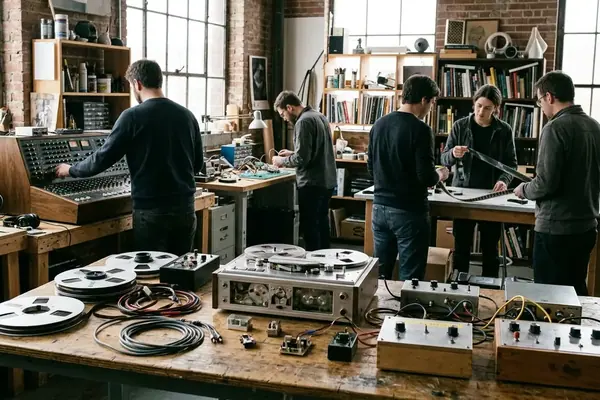
Around late 1999, the venue acquired its signature asset: a custom-wired quadraphonic sound system salvaged from a decommissioned university theater. The four-channel array allowed composers to move sound physically through the room, surrounding listeners rather than projecting at them.
The quadraphonic system rewarded a particular kind of attention. Its effectiveness varied drastically depending on whether the audience stood centrally, inside the sweet spot, or pushed against the brick perimeter walls where the channels collapsed into something muddier and more chaotic.
That unevenness was not a flaw the curators rushed to fix. It made the room itself a participant—a space where where you stood changed what you heard.
The Ephemeral Archive: Limitations in Documenting Sound
Here the historian runs into a wall. Experimental music, especially the improvised and site-specific work Soundlab favored, resists the tidy preservation that visual art permits. A painting survives. A forty-minute feedback improvisation, performed once in a humid room with the dock doors cracked, does not.
The archivists who attempted to document the venue understood this early and adjusted their priorities accordingly. Rather than pour resources into remastering degraded cassette recordings, they concentrated on collecting physical ephemera—silk-screened posters and hand-drawn setlists, recognizing that the visual artifacts told a clearer institutional story than the audio could.
What audio survives is thin and specific. Most surviving documentation consists of direct-to-DAT board tapes recorded in the early 2000s, a narrow window that omits the venue's earliest and latest years entirely. The physical flyer archive is denser and more useful: a roughly eight-year window cataloging, per gallery data, more than 400 distinct performances, each poster a small record of who played, when, and for whom.
Note: Relying on surviving board tapes gives an incomplete historical picture. The physical sensation of sub-bass frequencies vibrating up through the concrete floor cannot be reproduced in standard archival playback. The recordings preserve the notes; they lose the room.
This is the honest limit of any study of the space. Oral histories fill some gaps, and the flyers anchor the chronology, but the true acoustic experience—the thing that made a Soundlab night a Soundlab night, remains lost to time. Any account of this scene, including this one, works from fragments and should be read as such.
Reverberations: Soundlab's Lasting Impact on Western New York
Soundlab altered the cultural DNA of Buffalo, and it did so without leaving a monument behind.
When the venue's peak years closed, contemporary organizers made a telling decision. Rather than reopen a physical replica—a nostalgic shrine to a room that could never be reconstructed, they redirected their energy toward funding mobile sound installations. The curatorial ethos survived by refusing to be pinned to a single address. The idea traveled even after the building could not.
The influence radiated outward in concrete ways. In curator evaluations, the operational model developed during the peak years, roughly 1999 through 2007, became a reference for at least three subsequent artist-run spaces across the broader Great Lakes region. Organizers in other post-industrial cities studied how Soundlab balanced gallery rigor against club energy, and they borrowed the model.
The academy took notice as well. By the early 2010s, university sponsors folded the venue's curatorial history into graduate-level media study syllabi, treating the space not as a footnote but as a case study in how a city builds infrastructure for risk.
Summary: Soundlab mattered because it proved that an industrial city in decline could sustain a serious, uncommercial sound art practice—if someone built a room that took the work seriously. The lesson endures wherever artists need space to fail loudly.
That, finally, is the argument for spaces like this one. Contemporary art does not advance in venues optimized for ticket sales. It advances in rooms willing to absorb the ambient drone of their own cities and call it material. Buffalo built such a room once. The reverberations have not stopped.