Engineered electronics promise repeatability. Press the button, hear the sound, every time. Circuit-bending thrives on the opposite instinct—the moment a battery-powered toy misbehaves, sputters, and produces a tone its designers never sanctioned. That gap between intention and accident is where an entire performance tradition took root.
The practice sits at an odd intersection of frugality and rebellion. A discarded children's keyboard, purchased for pocket change at a rummage sale, becomes an instrument capable of vocalizations no synthesizer manufacturer would ever ship. Understanding how that transformation works—and how Buffalo's experimental community made it a cornerstone of live performance—starts with a short circuit against a desk drawer.
The Accidental Instrument: Origins of Circuit-Bending
In 1966, Reed Ghazala left a 9-volt transistor amplifier open on his workbench. The exposed circuit brushed against a metal desk drawer, shorted, and screamed. Most people would have flinched and reached for the off switch. Ghazala listened.
That single event, replayed and refined over the following decades, established a working method that ignored the schematic entirely. Rather than reading a device's intended signal path, the bender treats the printed circuit board as unexplored terrain, probing for connections that produce interesting failures. The engineering was already done; the artistry lay in breaking it productively.
What made the discovery so consequential was its accessibility. No formal training in electronics was required, no expensive laboratory. A curious hand, a battery, and a willingness to destroy the occasional toy were enough. The movement that grew from this spread through zines, workshops, and word of mouth, effectively democratizing electronic sound-making at a moment when commercial synthesizers remained the province of the well-funded studio.
Early gallery curators wrestled with how to frame this work inside a formal exhibition space. Their eventual solution—mounting the exposed, wire-tangled boards on pedestals beside more traditional instruments—signaled a decision that mattered: the bent circuit deserved to be seen as an object of craft, not merely a broken appliance.
The Anatomy of a Bend: Technical Fundamentals
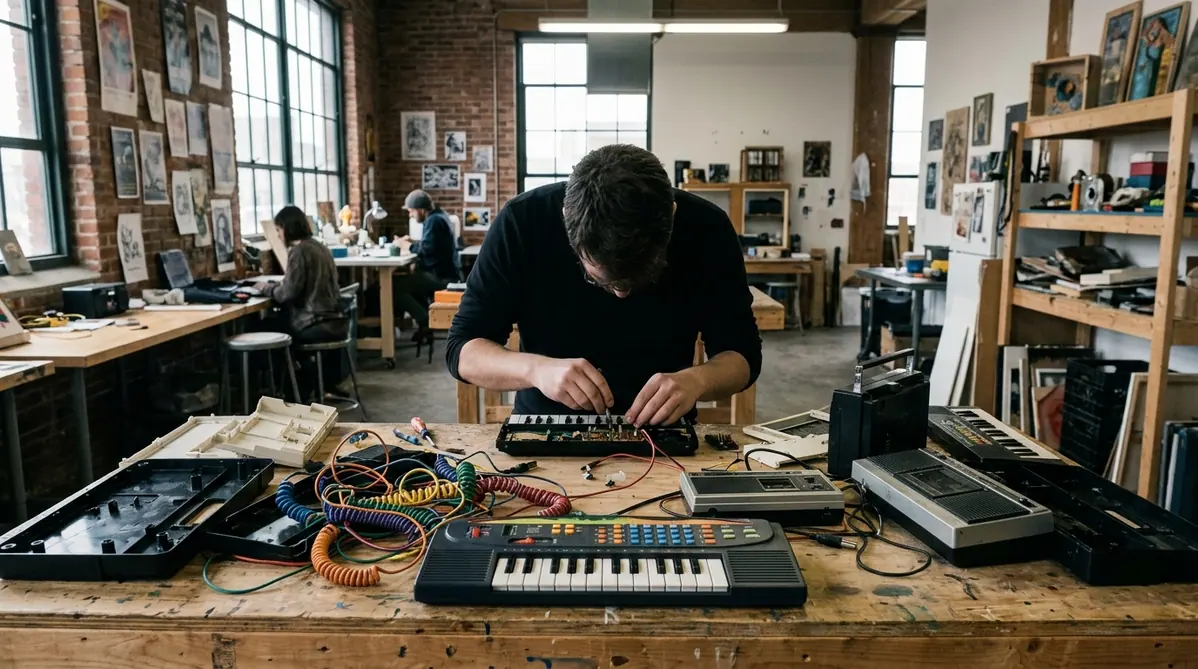
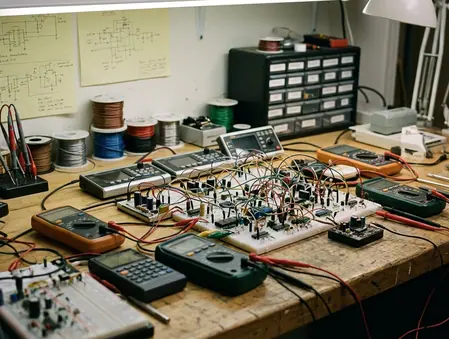
Opening a battery-powered device is the first tactile ritual. On the order of four screws, a plastic seam, and suddenly the guts are exposed—a green board flecked with solder points, resistors, and the timing chips that govern pitch and rhythm.
From here the technique is disarmingly simple. Touch two points on the board simultaneously and listen for a change. A wire works. So do damp fingertips, and this is where the medium turns intimate. Human skin resistance ranges from roughly 1,000 to 100,000 ohms depending on moisture, which means the performer's body becomes a variable component in the circuit. A dry hand and a sweaty one produce different results from the identical contact points.
Some early practitioners approached the board like engineers, mapping every logical junction with a digital multimeter to identify sanctioned connection points. That methodical survey rarely survived contact with the actual instrument. The productive bends—the stuttering, the pitch dives, the glitched loops—lived at connections no logic diagram would recommend. The 'wet finger' technique, exploratory and unrepeatable, found them faster.
Harnessing the Chaos
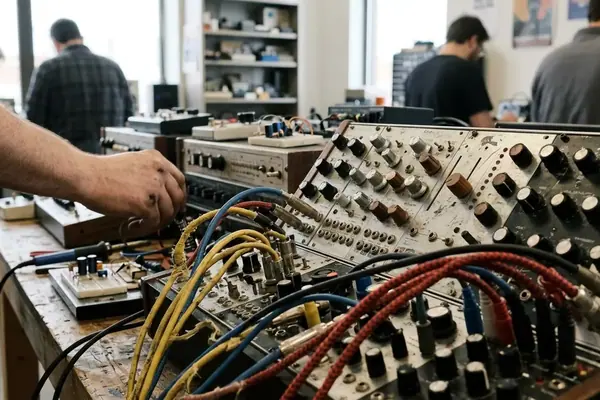
A raw bend is thrilling but ungovernable. To make it playable, benders install controls. Replacing a fixed timing resistor with a 10k to 500k linear taper potentiometer lets a performer sweep pitch by hand. Photoresistors introduce light as a modulation source, so a wave of the palm over a sensor bends the tone. Toggle switches lock a chosen connection into place, turning a fleeting accident into a reliable voice.
These additions convert a screaming board into an instrument with vocabulary. The Stanford CCRMA writings on principles of hardware hacking and electronic instrument design frame this same progression: locate the interesting instability, then build an interface around it.
Pitch and modulation shift with the ambient humidity of the room when a performer routes the signal through exposed body-contacts. The instrument literally responds to the weather in the space.
Navigating the Voltage: Safety and Creative Limitations
One rule defines the entire discipline and admits no exceptions: only battery-powered devices belong on the workbench. Operating voltages stay strictly confined to the 1.5V to 9V DC range, with a maximum safety threshold of 9 volts. Mains AC power is never bent. The distinction is not academic—it is the line between a fried toy and a fatal shock.
Community workshops formalized this boundary into intake protocol. Facilitators visually inspect each battery compartment before any device reaches the soldering table, screening out anything designed to plug into a wall. During an actual short circuit, current draws typically run between 200 and 500 milliamperes, well within the range a low-voltage board can tolerate without endangering the person holding it.
Capacitor Hazard
One catch bears repeating loudly: devices with internal flash capacitors, such as disposable cameras, can deliver a 300-volt discharge even after the primary battery has been removed. A stored charge respects no off switch. Anything with a flash unit stays off the table until fully discharged by someone who knows how.
The medium's unpredictability is its second defining trait, and unlike the voltage rule, this one is a gift as much as a constraint. Components fry. A bend that sang yesterday may fall silent today because a delicate solder joint gave up. Bridging the main power rail directly to the timing clock input, a common misstep, permanently kills a voice synthesis chip. Yet this fragility is exactly what draws performers in. The absence of traditional musical control—no fixed scale, no guaranteed note—forces a collaborative relationship with the machine. The bender proposes; the circuit disposes.
The Soundlab Era: Buffalo's Experimental Adoption
Buffalo's experimental community took to bent circuits with particular enthusiasm, and Soundlab became the room where it happened. Between roughly 1998 and 2004, the venue hosted a peak integration period during which local artists folded modified children's toys and salvaged electronics into full live sets.
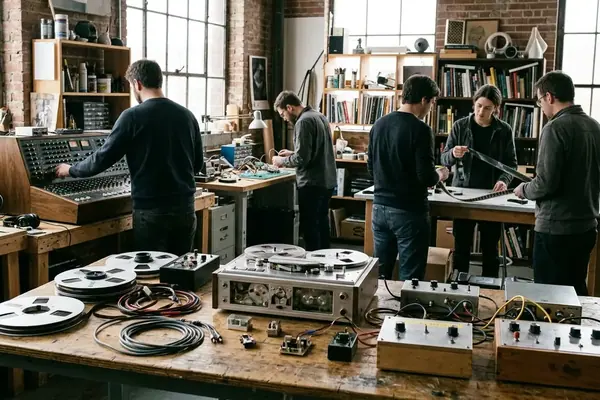
The aesthetic fit was almost too neat. Noise, industrial, and avant-garde performers valued texture over melody, rupture over resolution. A bent Speak & Spell shrieking through a chain of guitar pedals belonged naturally beside tape loops and feedback drones. The raw, erratic character of a modified toy supplied a sonic vocabulary the polished synthesizer simply could not.
Making these instruments audible in a live mix, however, took real engineering. The signals coming off bent toys were low-output and erratic, nothing like a standard line-level source. Where the venue's sound engineers documented their approach, the solution was to route those unruly signals through active direct injection boxes and add 20 to 30 dB of gain at the console to lift them up to the level of conventional instruments. Without that boost, a delicate bent voice would vanish under a single guitar chord.
That backstage adaptation reveals something about the scene's seriousness. Elevating a dollar-store keyboard to headline status required the same signal-flow discipline as any professional stage—the toy was treated as an instrument worthy of proper routing, not a novelty.
The Enduring Legacy of the Modified Toy
Circuit-bending performed a quiet act of cultural reclassification. It took objects engineered for disposal—the toy destined for a landfill within a year—and reassigned them to the status of performance instruments. In doing so, the practice mounted a direct challenge to planned obsolescence, insisting that a piece of consumer technology could have a second, richer life its makers never imagined.
Preserving that legacy proved its own puzzle. Archivists documenting the Buffalo scene eventually shifted strategy, moving away from maintaining the physical hardware toward capturing high-resolution audio stems. The reasoning was pragmatic. The fragile modified solder joints that made each instrument unique also made them impossible to keep alive indefinitely. The sound would outlast the object.
Consider the instrument that came to symbolize the whole practice. The Texas Instruments Speak & Spell, released in 1978, ran on the TMS5100—the industry's first single-chip speech synthesizer, clocked in the neighborhood of 250 kHz. Bend that clock input, and the tidy educational voice collapses into alien, stuttering vocalizations, pitch dropping toward frequencies nearing 20 Hz, where speech becomes a low mechanical growl. A chip built to teach children how to spell became, in the hands of Buffalo's noise artists, one of the defining voices of experimental sound.