Quick Nav
- The Challenge of Capturing Time-Based Actuality
- Bridging Photochemical Processes and Non-Linear Editing
- Structural Film, Body Art, and the Physical Canvas
- Cause and Effect: Installations and Poetic Maps
- The Boundaries of Archival Translation
- Institutional Backing and the Resulting Legacy
The Challenge of Capturing Time-Based Actuality
A performance disappears twice: first when the room empties, then when the surviving objects start to look ordinary.
Buffalo’s experimental film and art movements demand an archive that can read both event and residue. The obvious materials rarely tell the whole story. A program announces an evening, but a grocery list may disclose how an artist structured a sequence, priced a prop, or marked the rhythm of a day spent preparing for a work that no longer exists as a body in space.
Ephemera as working evidence
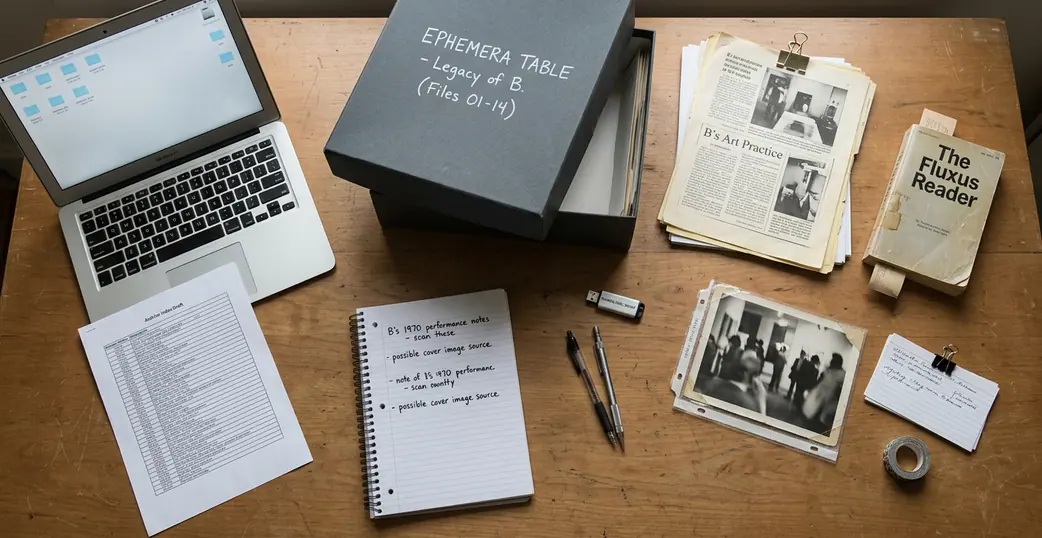
The archive around Ron Ehmke’s performance triptych The Dark Times, directed by Margaret Smith, shows the point with unusual clarity. Per gallery data, cataloging the physical ephemera required four archival boxes of grocery lists and ticket stubs, and the sorting alone took 14 to 18 days of continuous work. That duration matters. It signals that the archive did not treat scraps as decorative supplements; it treated them as a working taxonomy of rehearsal, circulation, and audience encounter.
The March 1998 collaborative interview adds a second layer. Captured on standard audio cassettes, it produced 112 minutes of unedited dialogue in the archival record. The cassette format carries its own historical texture: hiss, pause, interruption, and the practical limits of recording equipment all become part of the evidence. Here, documentation does not stabilize the performance into a single interpretation. It preserves friction.
Summary: Time-based actuality survives through linked traces: performance memory, informal paper, recorded speech, and the institutional patience required to keep fragile materials legible.
Bridging Photochemical Processes and Non-Linear Editing
Lawrence Brose’s experimental filmmaking sits at the productive seam between hand-built cinema and digital composition. In De Profundis, Brose drew on found home movies and Oscar Wilde’s 1895 prison letter, bringing private image fragments into contact with a text already marked by confinement, desire, and address.
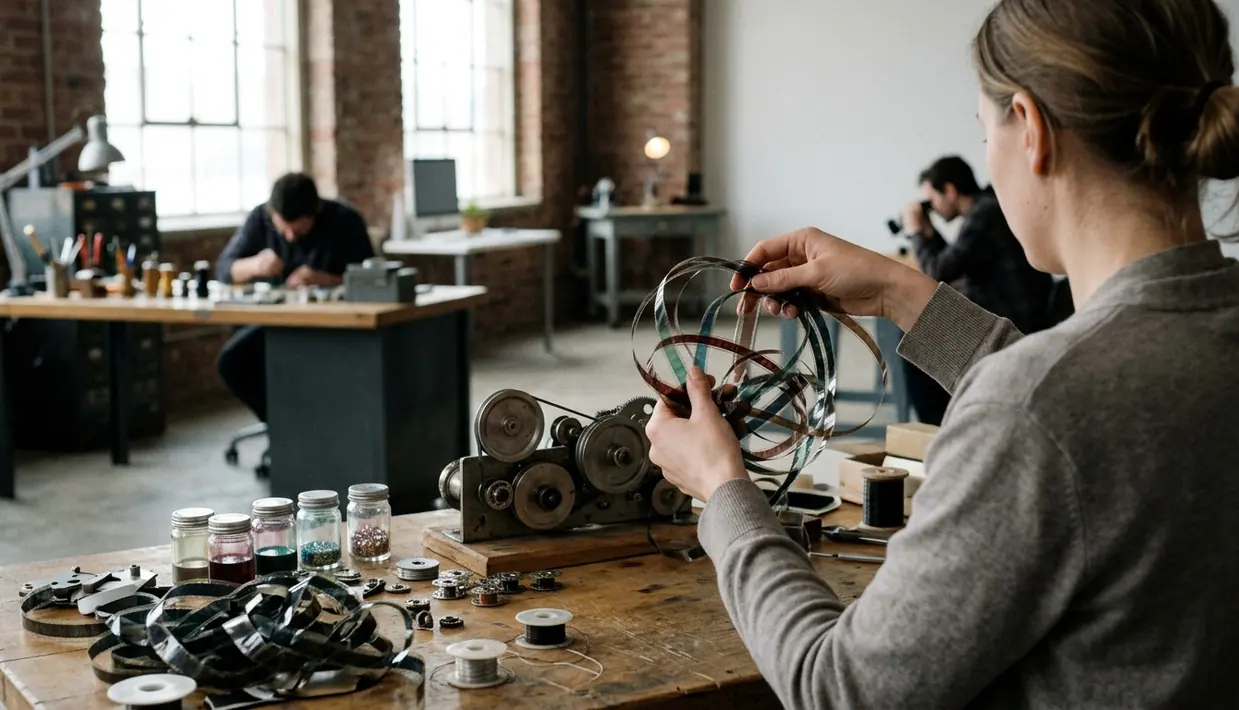
The material procedures were exacting. Photochemical processes, optical printing, and manipulation of hi-con movie film stock shaped the image before any digital translation entered the workflow. Manual frame-by-frame optical printing required roughly 3 to 5 seconds of exposure per frame, a tempo closer to engraving than to conventional editing. The film image emerged through duration, pressure, and controlled repetition.
When transfer becomes interpretation
The first digital problem was not philosophical; it was optical. Standard telecine transfers failed to capture the extreme contrast of hi-con film stock without severe blooming. The high-contrast silver halides overwhelmed the digital sensors, so the transfer process had to be reconsidered rather than merely repeated.
This is where analog and digital practice begin to resemble each other conceptually. Early non-linear editing sessions on Macintosh systems from the early 1980s were restricted to rendering sequences in the neighborhood of 5 minutes at a time because hard drive storage imposed severe constraints. Yet non-linear editing also made a persuasive analogy to digital writing: sequence, revision, insertion, and deletion became visible as compositional acts rather than hidden technical afterthoughts.
Brose’s practice therefore resists a simple analog-to-digital progress story. The photochemical image did not become obsolete when the digital workstation arrived. Instead, each system exposed the other’s limits.
Note: Standard transfer methods can record an image while misreading its material character. For hi-con stock, contrast is not a surface effect; it is part of the film’s structural argument.
Structural Film, Body Art, and the Physical Canvas
Paul Sharits, a University at Buffalo faculty member who died in June 1993, remains central to any account of Buffalo’s structural film inheritance. The November 1991 exhibition at Big Orbit Gallery and Hallwalls Contemporary Art Center placed that inheritance in a shared institutional frame, one suited to the city’s appetite for projection, duration, and spatial intervention.
During public installations, the structural 16mm film loops measured 24 feet, producing a 4-second repeating visual cycle. That measurement is not a neutral specification. It defines how attention behaves: the viewer does not simply watch an image return, but learns the interval of its return. The loop becomes a metronome for perception.
Live action against the measured loop
The Fluxaction performance during the exhibition opening complicated that metric discipline. It unfolded as a continuous action nearing 45 minutes, placing bodies, objects, and audience attention against the short recurrence of the projected loop. The contrast mattered. Structural film offered a rigorous temporal machine; live action introduced contingency, fatigue, and the social awkwardness of shared witnessing.
Bruce Adams’ August 1998 exhibition extended the argument through body art and the iconization of physical appearance. Adams approached the body as a cultural surface already saturated by middlebrow and lowbrow imagery. Rather than purify those references, he let them collide. The result reads less like a hierarchy of taste than a field map of Buffalo’s visual vernacular, where barroom signage, magazine glamour, studio gesture, and painterly self-consciousness can occupy the same canvas.
Cataloging reminder: When cataloging structural film with live performance, document loop length and action duration separately. One describes mechanical recurrence; the other describes embodied time.
Cause and Effect: Installations and Poetic Maps
Joseph Bergel’s September 1998 interactive balloon installation made causality visible without turning it into a classroom diagram. The work operated as an inflation-deflation event, mechanically timed per gallery data to a 12-minute and 30-second interval using industrial air compressors. Air, plastic, pressure, and sound formed a cycle that visitors could feel before they fully interpreted it.
Ian Monroe’s catalog essay supported that reading by framing the installation through cause and effect sequences. The strongest aspect of the work lies in its refusal to make interaction sentimental. The viewer did not control the system so much as enter its timing. That distinction keeps the installation close to experimental film, where sequence governs perception even when no narrative explains it.
Porter’s maps of unstable time
Kelly Porter’s April 1999 exhibition shifted the problem from mechanical interval to printed surface. Her etching, lithography, and monoprint methods produced what she termed poetic maps: layered fields where place, memory, and temporal drift operate through mark rather than illustration. The process moved slowly. Porter’s monoprints required a drying period bordering on 48 to 72 hours between the application of the etching and lithography ink layers, with drying time varying significantly based on the ambient humidity of the gallery space during the April 1999 exhibition.
Poststructuralism gave Porter a vocabulary for decoding time-based actuality without reducing it to chronology. A map, in this sense, does not locate a stable territory. It traces differences, delays, inscriptions, and partial readings. Her prints ask the viewer to navigate time as a surface that has absorbed pressure.
- Document the mechanical interval of interactive installations, including compressor timing and sound behavior.
- Record printmaking dependencies, especially drying periods shaped by gallery humidity.
- Separate artist terminology from archivist description so that poetic language and technical metadata remain readable together.
The Boundaries of Archival Translation
No archive fully preserves experimental and performance art. It can protect objects, stabilize descriptions, and make relationships searchable, but it cannot reinstall the exact room temperature, audience tension, projector vibration, or bodily uncertainty of a live Fluxaction.
That limitation becomes especially clear when tactile film decay enters digital translation. Producing large-format digital Iris prints required a pass on the order of 34 minutes per sheet to render the decay of film grain at 300 dpi. The labor was substantial, and the resulting prints carried real interpretive value. One catch: translating tactile film decay into large-format digital Iris prints inherently flattens the physical depth of the silver gelatin, so the archival record functions as a representation rather than a true facsimile of the original medium.
What the gallery can hold
The gallery allocated on the order of 1,200 square feet specifically for housing the physical remnants of performance pieces. That space did more than store material. It gave the archive a spatial logic: boxes, film, sound recordings, paper records, and installation residues could remain near enough to be compared.
Still, proximity does not equal recovery. A ticket stub can confirm attendance culture; it cannot reproduce the hush before a performance begins. A cassette can preserve those 112 minutes of dialogue; it cannot restore the posture of the speakers or the pressure in the room. The archivist’s task, then, is not to promise completion. It is to mark the boundary with precision.
Archival Protocol for Time-Based and Ephemeral Art
- Document exact physical dimensions of film loops and projection distances.
- Record ambient audio of mechanical projectors and installation equipment.
- Catalog performance ephemera such as stubs and notes using acid-free folders and clear descriptive fields.
- Preserve original sequencing when boxes contain rehearsal materials, correspondence, and audience traces together.
- Identify where a digital surrogate changes texture, scale, or spatial experience.
Institutional Backing and the Resulting Legacy
The preservation story culminated in the retrospective exhibition that ran for 42 days across September and October 2001. By that point, Big Orbit Gallery had assembled more than a display of past events. It had built an argument for Buffalo as a serious node in experimental film, performance, body art, print practice, and installation.
Institutional support shaped what became possible. Lawrence Brose’s residency at the Institute for Electronic Art at Alfred University provided 6 weeks of uninterrupted access to high-end rendering equipment. Funding from the Rockefeller Foundation gave the project a broader cultural frame, while the University at Buffalo lineage and the presence of Hallwalls Contemporary Art Center anchored the work locally rather than abstractly.
Buffalo’s experimental inheritance
Critical reviews describe a city whose experimental identity came from overlapping infrastructures, not from a single venue or personality. Richard Huntington, writing for The Buffalo News, helped make that activity visible to a broader public, but the deeper continuity came from artists, curators, technicians, and archivists who accepted instability as part of the medium.
Big Orbit Gallery, co-founded by Katrin Jurati, succeeded because it treated avant-garde work as both event and record. The gallery preserved what could be handled, named, timed, projected, and revisited, while leaving room for the irreducible remainder. Within the surviving materials, Buffalo’s legacy appears not as a regional footnote but as a dense experimental field, shaped by post-industrial aesthetics and sustained by institutions willing to care for difficult forms.