
Are Science and Art Truly Opposites?
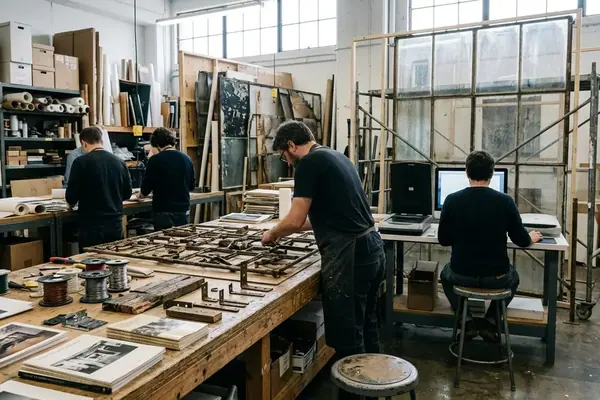
The inherited image of the scientist and the artist places them at opposite poles—one disciplined by measurement, the other liberated by intuition. Gary Nickard spends much of his practice dismantling this opposition. For him, the laboratory and the studio are not adversaries but cognate spaces, each devoted to the patient interrogation of phenomena.
Nickard occupies a distinctive position within Buffalo's experimental art community. As an artist whose work draws openly on optics, electronics, and environmental measurement, he treats the boundary between empirical inquiry and aesthetic production as porous, even fictitious. The dichotomy, he suggests, is a cultural habit rather than an epistemological necessity.
This piece emerges from three conversations, each nearing 90 minutes, recorded in late autumn of 2023. Rather than imposing a chronological account of his career, the editorial team grouped his responses around conceptual friction points—epistemology against aesthetics, precision against interpretation, drawn from roughly four and a half hours of raw audio. The result reads less as biography and more as a thematic map of a working mind.
The interview remains organized by those conceptual pairings.
The Laboratory as a Studio Space
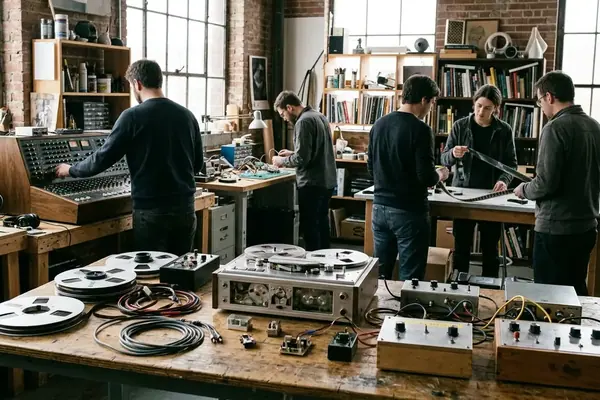
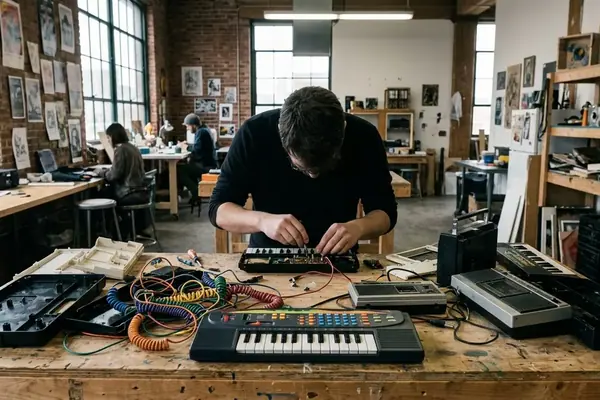
Nickard's installations begin with objects most institutions discard. He has spent years sourcing vintage electronics from university surplus auctions, a practice spanning roughly 1998 to 2014, accumulating a vocabulary of instruments long retired from their original duties. A convex lens, an obsolete oscilloscope, a forgotten meter—each arrives stripped of purpose and ready for re-inscription.
The aesthetic argument here is subtle. When a scientific apparatus loses its utility, it does not become inert; it becomes available to perception in a new register. Nickard works deliberately with this surplus of meaning, modifying the focal lengths of convex lenses on the order of 150mm to 300mm so that an instrument built for clarity now distorts, refracts, and stages the act of looking itself.
His academic formation shapes these choices. The same rigor that governs an experiment governs his curatorial logic—nothing enters the installation by accident, and every component carries the residue of its former discipline.
When Functionality Becomes a Liability
Not every experiment with apparatus survives contact with the gallery. For a 2018 installation, Nickard initially intended to use functioning, high-voltage cathode ray tubes, drawn to their genuine luminous behavior. The plan collapsed under the prohibitive liability insurance costs that gallery spaces required for live high-voltage equipment.
The lesson was instructive rather than defeating. Stripped of their working current, the tubes still held aesthetic charge—proof that the appearance of scientific function often communicates more than the function itself.
Navigating the Limits of Empirical Truth
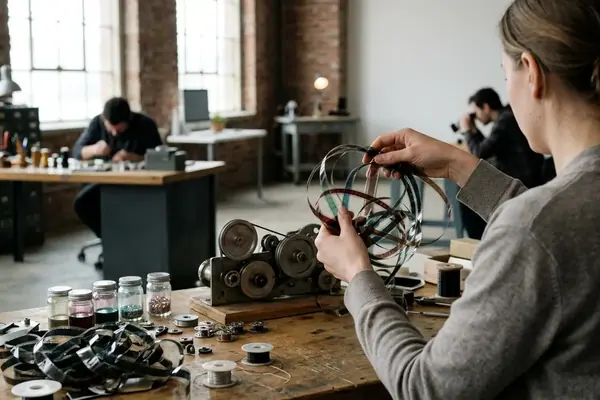
Nickard is candid about where data fails as an artistic medium. Scientific measurement excels at precision and falters at meaning; it can record a barometric reading but cannot register what that reading felt like to the body standing beneath the weather. The gap between the two is precisely where he locates the work of art.
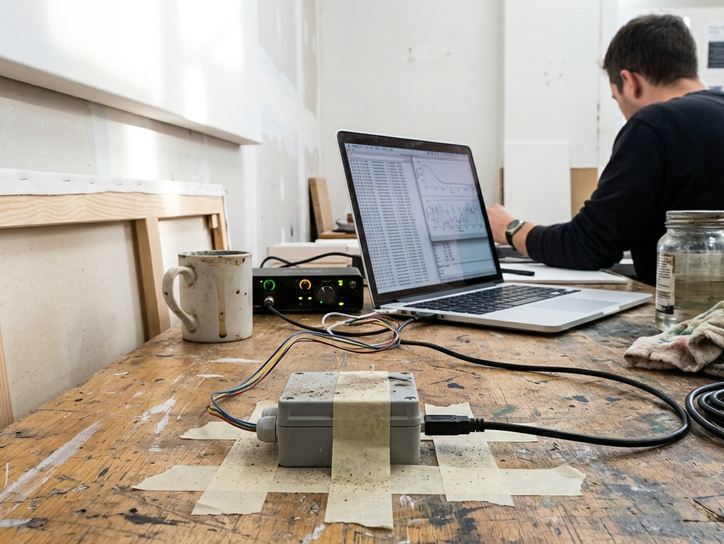
From commission records, one project translated 14 months of localized barometric pressure readings into acoustic frequencies, mapping the data across an audible spectrum from 40Hz to 400Hz. The selection process was itself an act of editing. Nickard filtered out raw meteorological data that lacked a human-scale narrative, choosing instead localized environmental readings that mapped onto a recognizable regional experience.
Note: Translating raw scientific data into acoustic or visual mediums inherently strips away the original mathematical precision, rendering the final piece an interpretive echo rather than a peer-reviewable dataset.
This caveat matters to him ethically as much as conceptually. To repurpose a scientific methodology for aesthetic ends is to accept responsibility for the distortion it introduces. The artist does not pretend to objectivity; he announces the interpretive frame openly, and in doing so converts a limitation into the honest premise of the work.
Empirical truth, in this reading, is not abandoned. It is metabolized—passed through perception and returned as something the instrument could never have produced alone.
Cultivating Buffalo's Avant-Garde Ecosystem
Nickard's relationship with Big Orbit Gallery sits at the center of Western New York's experimental history. The venue's physical character shaped what could happen inside it. Per gallery data, a 14-foot ceiling clearance and uninsulated brick walls gave installations room to breathe while imposing real constraints, and the most ambitious experimental audio rigs demanded up to 40 amps of dedicated power—an industrial inheritance Buffalo supplied readily.
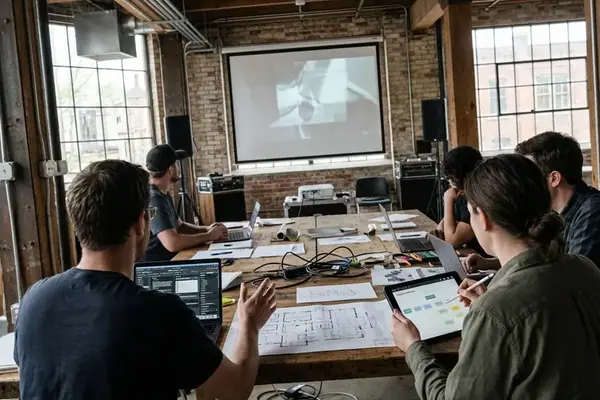
That industrial-academic landscape did more than house the work; it produced the conditions for cross-disciplinary encounter. The University at Buffalo seeded theory, the surplus auctions seeded material, and the warehouse architecture seeded scale. Few cities offered all three at once.
Curation as Deliberate Friction
Nickard's curatorial instinct favored productive collision. He would place a highly structured kinetic sculpture directly beside an improvisational sound work, letting two opposed methodologies argue across the floor. The viewer became the site where these contrasting logics resolved—or refused to.
The conditions were rarely forgiving. Delicate, uncalibrated vintage hygrometers occasionally failed mid-exhibition, undone by the fluctuating humidity of un-climate-controlled warehouse galleries. The aesthetic impact of repurposed optical equipment could shift drastically depending on ambient light bleeding in from adjacent streetlamps. These were not failures to be hidden but features of a practice committed to real conditions over laboratory sterility.
Critical review reveals a venue that treated unpredictability as a collaborator rather than an obstacle.
Future Trajectories in Interdisciplinary Art
Looking forward, Nickard is measured about the romance of art-science fusion in an increasingly technological culture. Access to tools, he notes, is not the same as understanding them. The danger for emerging practitioners is fluency mistaken for mastery—the borrowed vocabulary of science deployed without its underlying grammar.
His advice rests on a slow-integration method. He encourages students to spend a full academic semester mastering the operational mechanics of a single scientific instrument before attempting to make anything with it, dedicating in the neighborhood of 12 to 16 weeks of technical research to each project phase. Depth precedes gesture.
Advice for the Emerging Interdisciplinarian
- Master one instrument completely before reaching for a second.
- Treat technical research as part of the studio practice, not a preliminary to it.
- Name the distortion your medium introduces rather than concealing it.
- Document rigorously—Nickard has archived over two decades of exhibition schematics into a digital repository, preserving methods that would otherwise vanish.
Communities of practice continue to formalize these intersections, from regional venues to publications such as the Leonardo, the International Society for the Arts, Sciences and Technology, which has long documented the field's evolving methods.
Nickard's enduring argument is that experimental spaces like Big Orbit succeed not by erasing the line between science and art, but by making that line visible, contested, and generative. Readers should weigh these reflections as one practitioner's situated account rather than a universal method—the interpretive nature of this work resists tidy replication.
The legacy he describes is finally an ethic: approach the instrument with humility, the data with honesty, and the gallery with the patience to let opposites stand close enough to speak.