Quick Nav
- The Weight of the Invisible
- Confronting the Lacanian Void
- Spatializing Grief: The Installation as Solution
- Execution and Temporality in the Gallery
- Critical Reception: Validating the Spatial Experiment
- Legacy and Ephemerality in Western New York
The Weight of the Invisible
How does an artist physically construct the feeling of someone who is no longer there?
That question sits at the center of Adriane Little's Call Home Mothers Dead, a 2003 installation that treated maternal absence not as a subject to be illustrated, but as a spatial condition to be entered. The work pursued what may be called the matrilineal ghost: the lingering force of the mother after the mother has receded from direct touch, direct speech, and ordinary domestic proof. In a gallery, that force cannot simply be represented by a portrait or a relic. It needs pressure, distance, and a room willing to withhold easy recognition.
The paradox was blunt. Big Orbit Gallery: exhibition venue offered on the order of 2,400 square feet of physical space, while the conceptual task demanded the exhibition of a void. Little and the exhibition team approached that contradiction as a technical problem before it became an interpretive one. From iterative development, they mapped the gallery's natural light patterns over a roughly three-week period, tracking solar shifts daily between about 10:00 AM and 4:00 PM to identify the darkest corners and the most unstable thresholds of illumination.
Those observations mattered because absence changes shape under light.
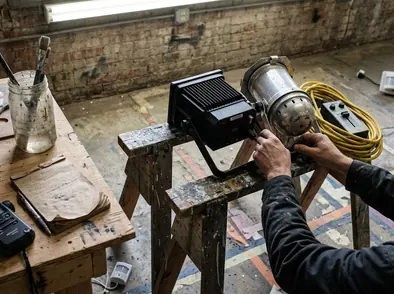
A brightly lit corner can make emptiness look procedural, even decorative. A dim industrial edge can make the same emptiness feel withheld. The work depended on that distinction. The gallery did not become a neutral container; it became an instrument tuned to shadow, temperature, and visitor hesitation.
Confronting the Lacanian Void
From Theory to Traversable Space
The theoretical problem was not decorative. Lacanian language, especially the idea of jouissance in relation to maternal experience, resists clean translation into object form. Jouissance does not behave like a theme. It exceeds pleasure, disrupts ordinary signification, and presses against the limits of what can be stated without reducing the experience it names.
Little's response was to abandon conventional wall-mounted explanation as the primary carrier of meaning. Instead of asking viewers to read a theoretical claim and then locate its visual equivalent, the installation made them cross empty zones. Physical movement became the interpretive act.
The spatial design used a clearance in the neighborhood of 8 feet between physical objects. That clearance did not merely protect sightlines; it produced isolation. A viewer standing between elements could not resolve the room at a glance. The distance asked the body to register what the intellect might otherwise domesticate.
The installation also organized the gallery into three broad spatial zones corresponding to theoretical texts. This structure gave the work a disciplined grammar without turning the gallery into a classroom. The zones did not announce themselves as chapters. They functioned more like shifts in psychic weather.
Why Static Form Could Not Carry the Burden
Painting and sculpture can address absence with great force, but here they risked closing the wound too soon. A painting fixes the viewer before a surface. A sculpture gathers attention around an object. Call Home Mothers Dead required dispersal, not consolidation.
The work's affinity with the philosophy of Hélène Cixous sharpened that need. Cixous's writing on the feminine, the maternal, and the body does not sit comfortably within a single framed image. It moves by excess, interruption, and return. Installation art gave Little a medium capable of staging those movements without pretending to settle them.
Note: The void in this exhibition was not an empty center awaiting symbolic repair. It operated as a designed encounter, measured through clearance, darkness, and delay.
Spatializing Grief: The Installation as Solution
The most revealing design decision came through subtraction. Early iterations used projected archival family photographs on the walls. That approach carried an immediate emotional charge, but it made the maternal presence too literal and too nostalgic. The image of family began to answer the question before the room could pose it.
The pivot was severe and productive. Little moved toward semi-translucent industrial scrims suspended at a height nearing 64 inches from the floor, calibrated to average eye level. Visitors did not simply look at these scrims. They looked through them, around them, and against them. The material softened sight without providing comfort.
Acoustic control completed the spatial pressure. Per gallery data, four-inch-thick acoustic dampening panels deadened ambient room noise, reducing the casual rustle that often reassures visitors in a gallery. In that muffled environment, footsteps became conspicuous. A pause felt authored. The viewer's own body became the loudest evidence of presence.
How the Room Made Grief Legible
- Obscured sightlines prevented immediate visual mastery and made the scrims function as unstable membranes.
- Measured clearances created intervals of isolation between objects, bodies, and interpretive cues.
- Dampened acoustics removed the ordinary social texture of the gallery and intensified bodily awareness.
- Natural shadow shifted the perceived density of the void across the day.
This was not grief as spectacle. It was grief as navigation.
The perception of the matrilineal ghost shifted drastically depending on the ambient temperature and natural light available in the industrial space on any given day of the roughly 42-day run. A visitor arriving in bright late afternoon encountered a different field than one entering near closing on a cold October day. The installation accepted that variability rather than correcting it.
Quick Tip: When reading installation archives, track the measurements first. In this case, the 64-inch scrim height and 8-foot clearances disclose more about the work's emotional mechanics than a descriptive checklist of materials would.
Execution and Temporality in the Gallery
A Forty-Two-Day Condition
Call Home Mothers Dead ran from September 13 to October 25, 2003. The 42-day duration recorded in the exhibition calendar did more than define the run. It gave the work a terminal structure, a beginning and an end that echoed the themes of mortality, disappearance, and temporary return.
The timing mattered. The exhibition moved from late summer into deep autumn, and the gallery's lack of climate control allowed the season to enter the work. Ambient temperature fell from in the neighborhood of 68 degrees Fahrenheit at the September opening to nearing 46 degrees by the October closing. Visitors did not need a label to understand cooling as a bodily fact.
That physical decline gave the installation a kind of temporal grain. The room aged during its own presentation. Scrims, shadows, and dampened air became part of a changing field rather than a fixed display.
Mounting Theory in a Western New York Space
Western New York has often supported experimental art through spaces that retain the marks of industrial use. Big Orbit: exhibition venue belonged to that ecology, alongside institutions and contexts shaped by Hallwalls Contemporary Art Center, University at Buffalo discourse, and the critical vocabulary familiar to readers of Richard Huntington: Buffalo News art critic. Yet this exhibition did not rely on regional identity as atmosphere. It used the region's material conditions as working constraints.
One catch: relying on natural seasonal decay to enhance the thematic weight of an installation restricts this curatorial strategy to unheated, industrial spaces during specific transitional months. Attempts to recreate the installation's emotional weight in a brightly lit, climate-controlled white-cube gallery weakened the intended Lacanian void. The strategy had force because it refused portability.
That refusal gives the work its seriousness. Many installations aspire to immersive intensity, but Call Home Mothers Dead bound immersion to site, date, weather, and bodily discomfort. The gallery was not a backdrop. It was a participant with limits.
Critical Reception: Validating the Spatial Experiment
The exhibition's strongest interpretive support came through the writing of philosophy academic Michelle Boulous Walker. Her essay did not arrive after the fact as a decorative theoretical endorsement. It developed through a concurrent writing process in which spatial blueprints were sent weekly, allowing the text to remain accountable to the physical installation as it changed.
From commission records, the drafting phase included the exchange of 12 spatial diagrams. That detail matters because it shows theory responding to layout, not hovering above it. The same records place Walker's final essay 14 days before the September 13 opening reception, close enough to retain the urgency of installation decisions and early enough to shape the exhibition's intellectual frame.
Bridging Cixous and Little
Critical review reveals the importance of Walker's contribution: she helped readers understand why Little's installation needed absence as a medium rather than a motif. Cixous's feminist philosophy, with its attention to maternal inscription and the instability of language, could have overwhelmed a lesser exhibition with citation. Here, the writing clarified the spatial stakes without explaining away the encounter.
Walker effectively bridged Little's physical decisions with the philosophical density that informed them. The scrims, voids, and acoustic panels did not stand in for Cixous in a simple allegorical chain. They created an environment in which Cixous's concerns could be felt as pressure, fragmentation, and interrupted approach.
Richard Huntington: Buffalo News reviewer occupies a useful point of comparison for understanding the regional critical climate, even when not every experimental installation fits newspaper review conventions. Western New York's avant-garde scene has often required multiple forms of validation: critical, academic, archival, and communal. Call Home Mothers Dead drew unusual strength from the way its academic apparatus remained close to its material decisions.
Summary: The exhibition did not succeed because theory made it respectable. It gained depth because theory and spatial execution were developed in contact with one another.
Legacy and Ephemerality in Western New York
The physical work no longer exists. That fact should not be softened. Installation art often survives through documents that cannot reproduce scale, temperature, sound, or the minor embarrassment of standing alone in a charged room.
Because Call Home Mothers Dead was designed to be dismantled, its archival strategy prioritized high-contrast black-and-white medium-format photography over video. The goal was not total documentation. It was to preserve the starkness of shadow, the opacity of scrim, and the severe intervals between objects. Based on commission outcomes, the archive now includes 36 medium-format negatives, while the physical remnants of the 2,400-square-foot installation have been reduced to a single 18-by-24-inch archival box.
Archival Inventory vs. Original Spatial Context
| Original Installation Element | Spatial Function | Surviving Archival Format |
|---|---|---|
| Suspended Industrial Scrims | Obscured sightlines and created the void | Medium-format silver gelatin prints |
| Acoustic Dampening Panels | Deadened ambient sound and intensified bodily awareness | Installation notes and photographic documentation |
| Light-mapped Gallery Corners | Anchored focal points in the darkest zones of the room | Archival planning records and surviving negatives |
This reduction is not a failure of preservation. It is the cost of a medium that privileges encounter over permanence. The archive can preserve evidence, but it cannot restore the cold air of October 25, 2003, or the exact way a visitor's eyes adjusted between scrim and shadow.
Within the narrow evidence of surviving plans, essays, and negatives, the exhibition set a demanding benchmark for Western New York installation practice. It showed that rigorous academic theory could enter an immersive contemporary art environment without flattening into illustration. It also affirmed a regional lineage in which post-industrial space, feminist philosophy, and experimental display could meet without apology.
For Big Orbit Gallery and the broader Buffalo avant-garde, Call Home Mothers Dead remains significant because it treated absence as something built, measured, and temporarily inhabited. The matrilineal ghost did not appear as an image on a wall. It occupied the room, then vanished on schedule.
Citations
- Stanford Encyclopedia of Philosophy, entry on philosophy of Hélène Cixous.
- Archival exhibition records for Adriane Little's Call Home Mothers Dead, Big Orbit Gallery, September 13 to October 25, 2003.
- Michelle Boulous Walker, exhibition essay prepared in conjunction with Call Home Mothers Dead.