Quick Nav
- Defining the Ephemeral: The Curator's Dilemma
- The Ethics of Archiving the Temporary
- Technical Documentation Strategies
- Material Conservation of Remnants
- Re-Exhibiting the Archive
- The Final Transformation
Defining the Ephemeral: The Curator's Dilemma
An ephemeral installation is an artwork fundamentally bound by time. It decays, dismantles, disperses, or disappears after its initial exhibition, not as an accident but as part of its structure.
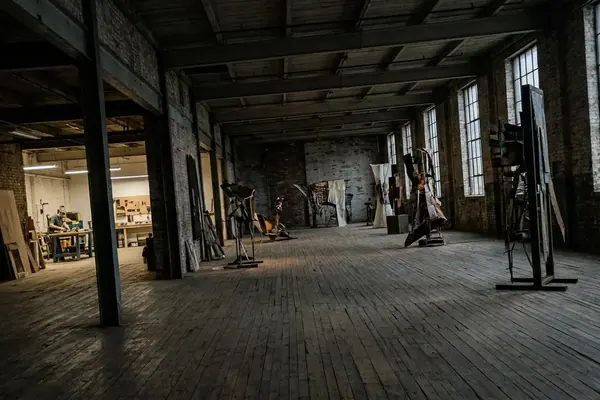
Picture an unfired clay floor piece at Big Orbit Gallery: exhibition venue, still damp at the opening, crossed by shallow fissures before the second afternoon. Nearby, raw botanical matter leans out of its armature. The gallery has not failed the work. The work has entered its next state.
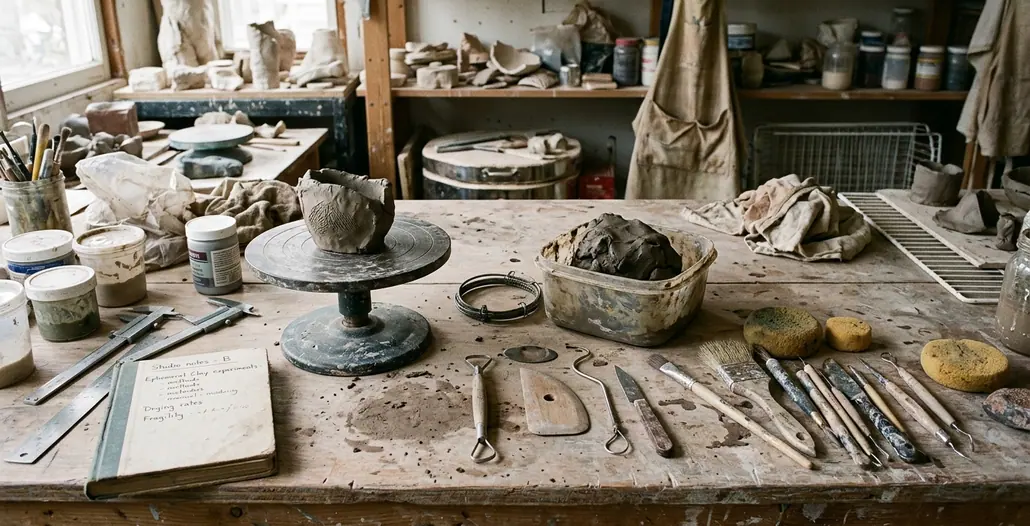
Curators often establish the boundary of the ephemeral by looking at the physical degradation timeline of the materials, not only the artist's conceptual pitch. Unfired clay and raw botanical installations typically show visible structural degradation within roughly 48 to 72 hours of installation. That short window changes the archival question from what should be kept to what can be understood before the work alters beyond recognition.
The central tension stays uncomfortable: how do curators and historians preserve an experience that was explicitly created to die?
The answer is not to freeze time. Archiving the temporary means translating a spatial, sensory, and social event into a durable historical record. A review by Richard Huntington, Buffalo News art critic, may capture one public reading. A floor plan may hold the geometry. A fragment of clay may preserve material evidence. None of these equals the installation, but together they give future readers a disciplined way to approach it.
Summary: The archive does not rescue an ephemeral artwork from disappearance. It records the terms of that disappearance with enough care that later audiences can study the event without mistaking the record for the work.
The Ethics of Archiving the Temporary
Over-preservation can violate the avant-garde artist's intent. A chemical sealant may look like care from a distance, yet it can turn an unstable sculpture into something the artist never made.
One cautionary example has become familiar in conservation discussions: attempting to freeze a decaying latex sculpture with chemical sealants can accelerate structural collapse rather than preserve it. The impulse is understandable. The conservator sees loss coming. The artist may have placed loss at the center of the piece.
Curatorial scope should be set before opening night, while the installation still exists in its intended social and architectural context. The most useful tool is a formal decay directive drafted with the artist. This document states when intervention is permitted, which changes belong to the work, and which remnants may enter the archive.
Drafting a formal decay directive often requires in the neighborhood of 2 to 3 hours of recorded dialogue with the artist to map acceptable degradation thresholds. The conversation should remain concrete: if the botanical matter collapses, does the armature stay visible? If a sound component drifts out of tune, should staff recalibrate it? If visitors track clay dust across the floor, is that contamination or participation?
Where Tate's work on conservation of time-based media helps frame the issue, the broader lesson is that change-based artworks require documentation of behavior, not only appearance. For installations whose decay is part of the work, documentation remains an interpretive act rather than a neutral copy.
Set the boundary before the archive begins
- Ask the artist what must be allowed to decay without intervention.
- Identify which components carry evidentiary value after dismantling.
- Record the artist's language around acceptable damage, exhaustion, odor, noise, and residue.
- Attach the directive to the acquisition file, exhibition file, and digital preservation package.
Note: A directive does not make the curator less responsible. It makes the responsibility visible, especially when later staff encounter fragments without the original installation in view.
Technical Documentation Strategies
Documentation begins with the room.
For installation work at Big Orbit: exhibition venue, the gallery's architecture is not a neutral container. A wall break, stairwell, concrete floor, or low ceiling can shape the piece as strongly as a plinth shapes a sculpture. Technical documentation should capture those relationships before it isolates details.
Continuous 360-degree video rigs can seem attractive because they promise total spatial capture. In practice, stitching artifacts may distort gallery lines and bend the very architecture the archive needs to preserve. A more reliable method uses medium-format photography from fixed positions, paired with wide-angle architectural video that moves slowly enough to read entrances, sightlines, and obstructions.
Ephemeral Installation Documentation Setup
- Record the artist interview to establish the formal decay directive.
- Map gallery architecture and plot medium-format camera positions.
- Position omnidirectional microphones roughly 3.5 to 4 meters apart for ambient soundscapes.
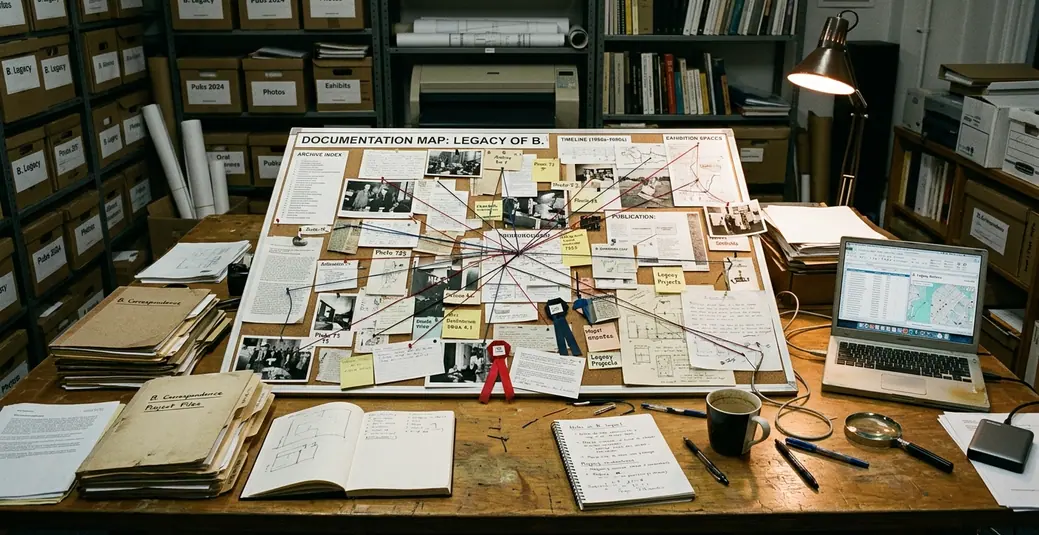
Audio deserves the same discipline as image capture. This matters in Buffalo's experimental arts history, where Soundlab performances and room-filling sound works often relied on reflection, vibration, and duration rather than melody. Ambient audio recording uses spaced omnidirectional microphones placed around 3.5 to 4 meters apart to capture room reflections and experimental soundscapes with useful spatial information.
Audio capture strategies also shift by artwork type. Close-miking helps when a localized kinetic sculpture clicks, scrapes, or breathes from a single point. Boundary microphones serve drone installations better because they listen to the room as a pressure field rather than to one object.
Make the room legible
- Create a scaled floor plan with wall lengths, entrances, columns, ceiling changes, and visitor paths.
- Mark camera positions, lens direction, and approximate field of view.
- Draw lighting diagrams that record fixture position, color temperature when known, and shadow behavior.
- Log audio microphone placement on the same plan used for photography.
These maps may feel dry beside the installation itself. Later, they become the difference between a poetic memory and an archive that another curator can responsibly interpret.
Material Conservation of Remnants
After dismantling, remnants need triage before they need romance. Organic matter, industrial debris, paper, textile, latex, dust, and hardware do not age together politely.
The first step is separation. Biological materials should go through immediate dehydration protocols before they enter the main archive, because mold spore migration can threaten neighboring collections. One catch: dehydration protocols fundamentally alter the cellular structure of organic matter, so the preserved remnant will shrink visually and shift in color compared with its live exhibition state.
Handling sequence for physical leftovers
- Photograph each remnant in place before removal, including surrounding residue or floor marks.
- Assign a temporary field identifier before cleaning, trimming, or bagging.
- Separate organic material from inert industrial debris at the worktable.
- Dehydrate biological matter before it approaches the main archive.
- Place mixed-media debris in Mylar enclosures on the order of 3 mil.
- Store sensitive remnants in an acid-free, climate-controlled environment maintained between about 18°C and 20°C.
Isolation protocols protect the collection from the remnant, and the remnant from the collection. That double obligation matters when an installation includes rusted metal, soil, plant matter, pigment, and paper labels in one pile. The archive should not let a vivid fragment damage a quieter one.
Quick Tip: Label a remnant as evidence of an event, not as the artwork itself, unless the artist's directive states otherwise.
This distinction can feel severe, but it keeps the historical record honest. A dried leaf from an installation is not the living botanical mass that visitors smelled in the room. A latex scrap is not the sagging, light-reactive form that occupied the wall. The remnant carries contact, material truth, and dateable evidence; it does not carry the full event.
Re-Exhibiting the Archive
Re-exhibiting an ephemeral archive is not reconstruction by stealth. The curator should show the audience how the record works.
Two approaches often sit side by side. One treats documentation as a quiet study room: vitrines, labels, contact sheets, directives, and floor plans. The other builds an atmospheric echo through sound, projection, and carefully scaled images. The second approach can move visitors, but it also carries the risk of false immediacy.
A useful compromise presents installation schematics at reduced scale rather than life-size. The choice keeps the audience from mistaking the documentation for a direct recreation of the original work. It also invites close reading, the way one reads a score rather than confuses it with the performance.
Framing the archive for a new audience
- Use vitrines for remnants, especially fragile paper, textile, botanical, or mixed-media evidence.
- Pair remnants with ambient audio when sound shaped the original encounter.
- Project schematics at reduced scale to signal interpretation rather than replacement.
- Display the decay directive so visitors can see what the artist permitted to vanish.
- Include critical reception when available, such as period writing connected to Hallwalls Contemporary Art Center, Big Orbit Gallery, or University at Buffalo networks.
Vitrine lighting should remain capped near 50 lux to protect sensitive paper and textile remnants from UV degradation during a roughly 6-week exhibition run. That low light level changes the mood of the room. It asks visitors to slow down.
Curatorial framing can help without overexplaining. A label might say that the projected line drawing shows the installation's footprint, not its body. Another might identify a clay fragment as residue collected at dismantling, not as a portable version of the sculpture. This language gives the audience permission to appreciate the archive as a historical echo.
Note: The most generous re-exhibitions do not pretend to restore the original encounter. They make absence readable.
The Final Transformation
The archive is vulnerable too.
Digital files can look clean in a collections database: image folders, preservation masters, audio stems, video documentation, checksums, metadata records. Their order can create a false sense of permanence. In practice, the digital surrogate of an ephemeral artwork requires the same kind of sustained attention as the artwork's clay, latex, or plant matter once did.
A proactive digital migration schedule treats files as active entities. Rolling checksum verifications test whether a file has changed at the bit level. Migration cycles move content away from failing drives, aging tape formats, unsupported codecs, and machines that no longer have available parts.
Preserve the surrogate without mistaking it for permanence
- Keep preservation masters separate from access copies.
- Run checksum verification on a rolling schedule rather than only after a crisis.
- Track hardware dependencies for audio, video, and image formats.
- Document each migration as part of the object's provenance.
- Review whether metadata still explains the original installation's spatial and temporal conditions.
This final transformation can feel ironic, but it is also clarifying. The digital archive of a disappearing installation becomes another temporary system: dependent on electricity, storage media, file formats, staff memory, and institutional care. Big Orbit Gallery's avant-garde history survives not because a single copy was saved, but because the record keeps being moved, checked, and recontextualized.
Magnetic tape and standard hard drives often face hardware obsolescence and bit rot within a roughly 10 to 15-year window, requiring active migration cycles roughly every 5 to 7 years.