Did a Single Pen Shape Buffalo's Avant-Garde?
The newspaper critic as civic translator
Before exhibition listings migrated online, a local newspaper review could change the weather around a show. Richard Huntington, Buffalo News reviewer and later remembered as a defining Buffalo News art critic, occupied that charged position in Western New York: he translated contemporary art for readers who might never walk into an artist-run loft, a university gallery, or Big Orbit Gallery, the exhibition venue that helped hold the region’s experimental edge.
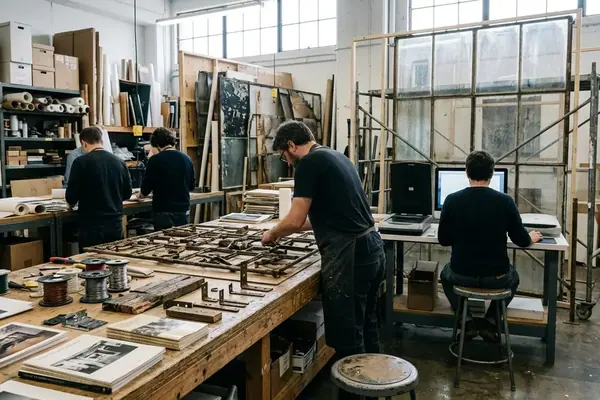
The visual record is modest at first glance: yellowing clippings, halftone installation photographs, paste-up columns, section fronts folded along old delivery creases. The emotional effect is less modest. A clipped review carries the pressure of a public encounter, especially when the artwork under discussion resisted easy description.
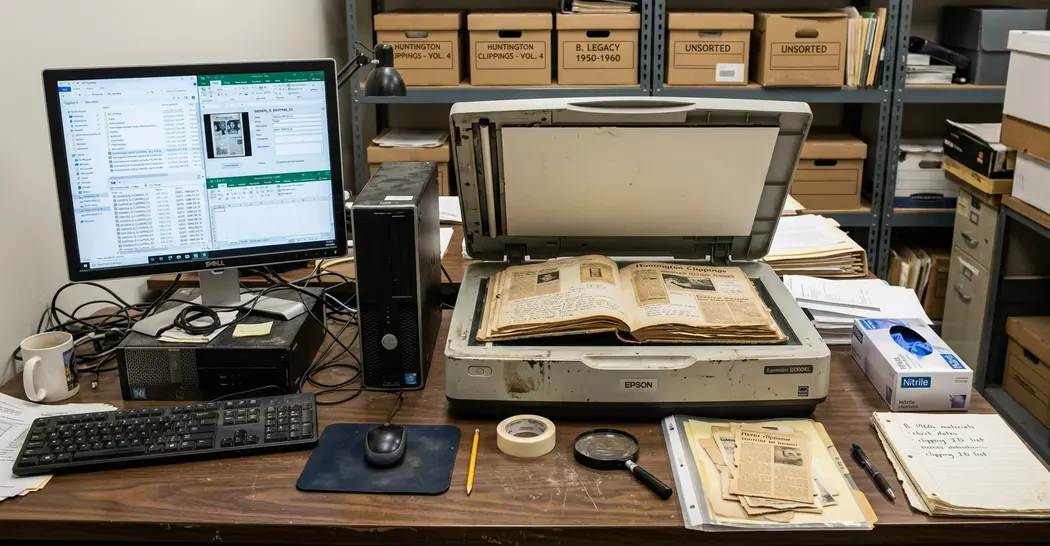
The editorial team mapped Huntington’s early 1990s clippings to trace how he made complex and confrontational installations legible as civic debate. He did not simply tell readers whether a show was beautiful. He asked what kind of public a work imagined, what kind of space it interrupted, and what kind of discomfort it required.
That role created tension.
Artists working in experimental forms often wanted ambiguity, noise, duration, and material roughness. A mainstream daily wanted clarity, deadlines, and a reader who could finish the column over breakfast. Huntington’s influence rested in that friction: he treated difficult work as something worthy of public attention without smoothing away all of its difficulty.
Gatekeeping and translation
Calling him a gatekeeper is accurate, but incomplete. A gatekeeper controls access; a translator alters the terms of access. Huntington’s reviews placed non-commercial exhibitions beside theatre listings, museum coverage, and Sunday arts features, giving readers a route into scenes that might otherwise have circulated only by word of mouth.
The reviews reveal a consistent strategy: he used description as an ethical starting point. The reader first learned where the body stood, how sound moved, what objects occupied the room, and only then received the conceptual argument.
Navigating the Industrial Underground
Reviewing raw space for a daily readership
Big Orbit’s history cannot be separated from industrial texture. The rooms mattered. So did the cold, the echo, the improvised lighting, and the social compact that brought viewers into spaces never designed for polite viewing.
In winter exhibitions at the Essex Street complex, reviewers encountered more than art on walls. They encountered unheated rooms, concrete floors, electrical improvisation, and installations that made the building itself part of the work. Huntington’s willingness to enter those conditions signaled respect before a single sentence appeared in print.
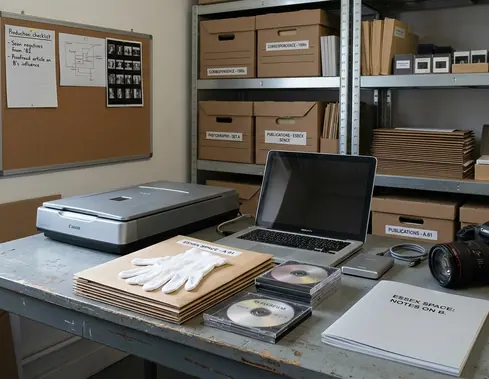
For a mainstream daily readership, this was delicate territory. A raw installation space could read as unfinished to one visitor and intensely deliberate to another. Huntington often wrote from that threshold, describing the physical discomfort without using it as a shortcut for dismissal.
Validation without domestication
One useful case pattern appears in reviews of site-specific installations in unheated industrial spaces. The critic’s presence validated the event as part of the region’s cultural record, yet the writing still had to explain why roughness was not simply neglect. When experimental sound performances lasted in the neighborhood of three hours, attendance itself became a form of critical labor. The review had to account for duration as an aesthetic material, not merely as a scheduling fact.
That distinction matters for Big Orbit Gallery and for nearby institutions such as Hallwalls Contemporary Art Center. Both belonged to a regional ecosystem where experimental art asked viewers to shift habits. Huntington’s reviews helped that request reach readers who had not been trained by the scene.
Quick Tip: When reading a review of an alternative space, note whether the critic treats the site as background or as medium. Huntington’s strongest pieces usually do the latter.
The validation was never neutral. Newspaper attention could bring new viewers, but it could also reframe underground practice through the expectations of a civic audience. That is the productive unease at the center of his influence.
Deconstructing the Huntington Method
Spatial intervention over medium
The archival team first tried categorizing Huntington’s reviews by medium: painting, installation, performance, sound, video. The system looked orderly and failed quickly. His actual critical framework leaned toward spatial intervention, especially the way artists manipulated rooms, thresholds, scale, sound, and bodily orientation.
This matters because medium categories can flatten avant-garde practice. A sound installation at Big Orbit might also be an architectural event. A sculptural environment might function like theatre without actors. Huntington’s method often followed the viewer’s body through the work, then turned that movement into an argument.
How the columns tend to work
- Begin with the room. He often anchored the reader in physical description before introducing theory.
- Identify the pressure point. The review then asked what the work disturbed: perception, memory, institutional authority, domestic comfort, or the gallery frame itself.
- Measure execution against ambition. Conceptual rigor mattered, but Huntington did not excuse weak realization simply because the premise was serious.
- Place the work in a longer conversation. References to mid-century modernist principles helped him contextualize contemporary chaos without reducing it to novelty.
His prose balanced curatorial density with newspaper pace. In a standard column on the order of 600 words, he had to spend enough space describing the encounter while still leaving room for interpretation. The balance was not always even, but the effort is visible: readers were given a scene before they were asked to accept a judgment.
His background as an artist sharpened the writing. He could recognize the difference between accidental roughness and chosen roughness, between unresolved execution and productive instability. That empathy did not make him soft. It made the criticism more exacting because he understood what the artist was attempting.
Comparison of critical styles
Some regional critics write as advocates, protecting fragile scenes from external misunderstanding. Others write as inspectors, testing every claim against formal discipline. Huntington’s best work moved between those modes. He could defend experimental ambition while still asking whether the piece had earned its demands on the viewer.
That mix suited Buffalo. University at Buffalo programs, independent artist-run spaces, and non-commercial galleries created overlapping publics rather than one unified audience. The shift in critical vocabulary when reviewing university-backed galleries versus independent spaces is worth tracking closely, because it shows how institutional context changed the burden of explanation.
The Boundaries of Newsprint: Scope and Limitations
What the format could not hold
Daily print criticism had hard edges. The Friday entertainment sections carried advertising demands, layout constraints, and copy-desk limits that shaped what readers saw. Exhibition analysis was frequently compressed by newsroom format constraints to a standard range of 450 to 600 words, and the turnaround from opening to print deadline was often less than 48 hours.
Those conditions reward clarity. They punish lingering.
A critic might enter a dense installation on Thursday night and need to produce public judgment before the work had settled in memory. That pressure does not invalidate the review, but it changes how archival readers should use it. The column captures a first public encounter, not a finished historical account.
Subjectivity in a concentrated scene
A single dominant critical voice can give coherence to a regional scene. It can also narrow the visible record. Huntington’s authority helped frame Buffalo’s experimental culture for a broad readership, yet his perspective inevitably carried preferences, blind spots, and habits of attention.
One catch: relying solely on published clippings obscures the broader regional dialogue, since letters to the editor and unpublished rebuttals from artists were rarely preserved by the publication. For this topic, the surviving newspaper record is a strong spine, not the whole body.
Note: A Huntington review should be read as a record of contact. It documents how one informed critic met the work under deadline, space, and editorial constraints.
The temporal nature of newspaper writing also sits uneasily beside the artworks themselves. Many installations were dismantled quickly. Sound performances disappeared into memory. The review, intended for a short news cycle, sometimes outlived the artwork it described.
That reversal can feel strange. The most permanent object may be the most provisional text.
The Archival Imperative: Preserving the Critical Record
From daily news to historical evidence
Huntington’s critiques now function as historical documents. Contemporary art historians use them to reconstruct exhibitions that left little behind: a few photographs, an announcement card, a checklist, perhaps a memory from someone who stood in the room. For site-specific sound installations, the published text and its accompanying halftone photograph may be the only paired evidence of what happened.
The preservation work begins with material vulnerability. The digitization workflow prioritized highly acidic mid-1990s clippings before more stable folders from the broader archive’s 1989 through 2007 span. Archivists scanned at a resolution high enough to capture halftone newspaper photographs, because those coarse images often contain installation details the prose only implies.
A practical preservation sequence
- Stabilize the clipping. Keep brittle newsprint flat, supported, and separated from more stable paper stock.
- Capture the whole page context. Section placement, neighboring ads, and headline scale help explain how the review met its original audience.
- Scan the article and image together. Attempting to reconstruct site-specific sound installations using only the published text without the halftone photograph leaves too much architecture behind.
- Create descriptive metadata. Record venue names, exhibition dates, artist names, and whether the space was university-backed, commercial, or artist-run.
- Contextualize, do not over-clean. Preserve evidence of newsprint, cropping, and layout because those features belong to the document’s history.
Repeated passes through the archive show a simple archival lesson: the clipping is not just a container for words. It is an artifact of publication, distribution, editorial priority, and public reception. That is why external repositories such as the Archives of American Art remain useful models for thinking about artists’ papers, ephemera, and critical documentation as interdependent records.
Why the record still matters
Buffalo’s avant-garde history was not built only in museums. It moved through Big Orbit, Hallwalls Contemporary Art Center, university galleries, industrial rooms, and nights when a small audience stayed with difficult work longer than convenience required. Huntington’s criticism offers one route back into those rooms.
It should not be treated as the final word.
Its value lies in disciplined proximity: a critic present in the space, writing under pressure, trying to make experimental work publicly discussable without stripping away its resistance. For archivists, that is precious evidence. For readers, it is an invitation to see local criticism as part of the artwork’s afterlife.
Summary: Huntington’s influence came from translation, not mere approval. His reviews carried Buffalo’s experimental exhibitions from temporary rooms into the durable record of regional art history.