Quick Nav
- How Big Orbit and Soundlab Filled the Basement
- Keeping Box Order Intact at Intake
- Reading Dates From Area Codes, Slide Stamps, and Zines
- The Three-Drawer Card Catalog
- Your First Ten Folders
How Big Orbit and Soundlab Filled the Basement With Unlabeled Paper
Between 1991 and 2011, Big Orbit Gallery and its Soundlab performance program turned over a show every three to five weeks. Two to four unpaid curatorial volunteers usually handled each changeover on weekend shifts. They hung work, struck it, mailed press kits, and swept the floor, and whatever paper was left on the desk went into the nearest corrugated transfer box.
Nobody labeled folders. There was rarely time, and often there were no folders.
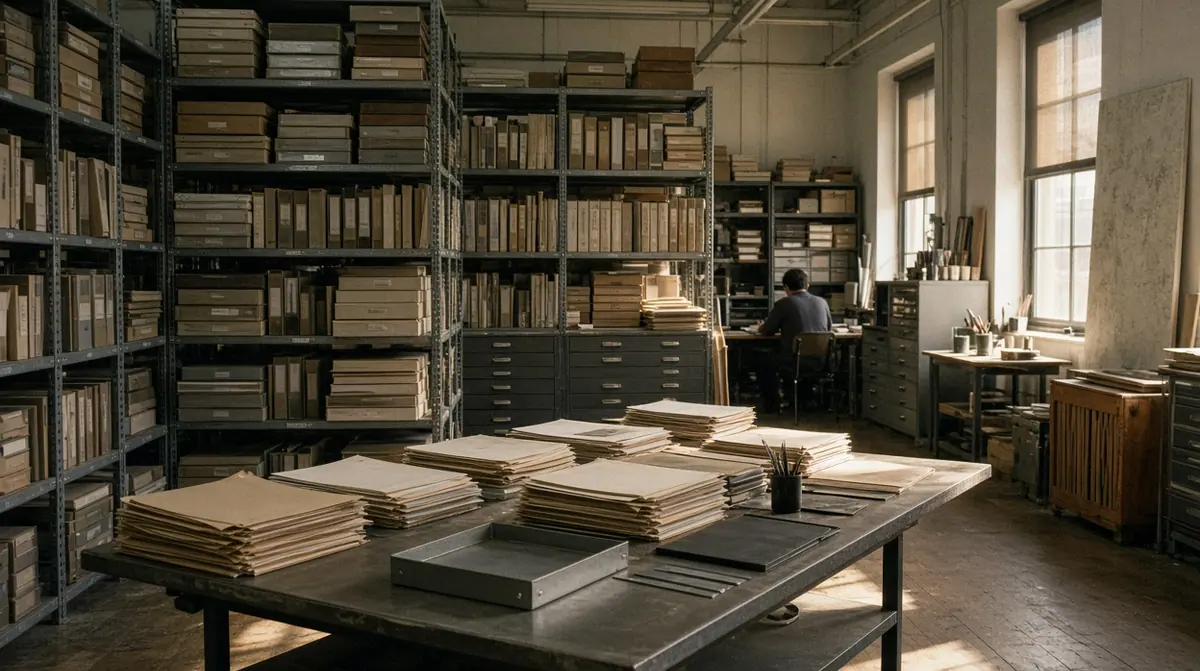
The result shows up in the numbers. A single 12-by-15-inch transfer box from the Main Street basement routinely held 60 to 85 unfoldered clusters: artist statements, gallery floor plans, unlabeled C-prints, technical riders scrawled on napkin-thin paper. When the archival team unpacked the 42 banker boxes, give or take, moved out of the Niagara Street and Main Street storage spaces, the obvious move was to sort by medium. That meant 35mm slide sheets in one cabinet, mini-DV tapes in another, and paper press kits in a third. The team weighed it seriously, then froze every physical grouping exactly as it came out of the basement.
The question behind that decision applies to any experimental venue that closes or changes hands. How do you make sense of decades of loose, undated ephemera before the people who remember the context move away? Volunteer-assembled records from spaces like Big Orbit, or its longtime neighbor Hallwalls Contemporary Art Center, rarely match the tidy accession files a university library expects. The approach below starts from that messiness and treats it as evidence.
Keeping Box Order Intact During the First Pass
The temptation arrives within the first ten minutes: dump the box, alphabetize by artist surname, and feel productive. Resist it.
A box of loose DIY paper behaves like an archaeological trench. Things that landed together usually happened together. An undated acoustic diagram sitting on top of a postmarked envelope tells you something the diagram alone never will. Breaking up adjacent stacks to alphabetize erases that stratigraphic link, and once it is gone, no amount of research brings it back.
The intake workflow, step by step
- Open one box and keep it in front of you. Work top to bottom and never pull from two boxes at once.
- Flag each physical cluster where it sits. Processors slide 8.5-by-11-inch unbuffered 20-pound bond paper flags between existing stacks, so an undated technical rider stays paired with whatever rests directly beneath it.
- Write a batch code on each flag with a 6B soft graphite pencil, using a sequential format such as BOG-B04-C12 (box 04, cluster 12). Soft graphite stays legible and never bleeds.
- Pull the corrosive and fugitive material. Remove rusty staples and paper clips. Curled thermal fax transmissions from the mid-1990s get photocopied onto alkaline paper within something like 48 hours of opening the box, then sleeved separately in 3-mil polyester L-velum before their silver-gray text fades further. The photocopy goes back into the original cluster position.
Know When to Stop
This dry triage protects relational evidence in room-temperature paper holdings from volunteer-run spaces. It offers nothing to a box showing active mold, curling acetate film base, or damp basement water damage. Those go into isolation and on to a conservation facility for freezer stabilization, unprocessed. The Library of Congress guidelines on preserving paper and photographs are a sensible baseline for the dry material you keep.
Reading Dates From Area Codes, Slide Stamps, and Xeroxed Zines
Picture a portfolio that arrives without a single year anywhere. The bio mentions "recent work." The checklist names five pieces in a faint dot-matrix font. A folded handbill invites everyone to a Soundlab night with an address but no date.
It is a frustrating object and a fascinating one. Undated ephemera from Buffalo's alternative scene carries its timestamp in its materials, and the indexing workflow at this stage shifts away from the curatorial text. Processors cross-check the physical object against a master wall chart of Western New York municipal and print-production shifts.
Markers worth putting on the wall chart
- Phone numbers. A flyer listing regional suburbs under the 716 area code alongside seven-digit local dialing predates the October 2001 split that assigned 585 to the Rochester region.
- Slide mount stamps. Cardboard 35mm mounts bearing red-ink month-and-year processing stamps from regional photo labs narrow an undated installation view to a window of 14 to 30 days after the exhibition opened.
- Press release typography. Dot-matrix output, early laser printing, and later desktop layouts each cluster in recognizable periods for small-venue press kits.
- Xeroxed zine layouts and weekly mastheads. Changes in a local alternative weekly's masthead, or in the paste-up habits of a zine collective, bracket a clipping more tightly than its content does. A Buffalo News review by Richard Huntington, if one surfaces in the same cluster, can anchor a whole stack.
Recording what you find
Write the tentative range in square brackets on the upper-right tab of the new exterior acid-free folder, for example [ca. Autumn 1997–Spring 1998]. The original zine, handbill, or letter stays completely unmarked. Brackets signal an inference, which leaves the next processor free to revise it without wondering whether the date came from the artist.
The Three-Drawer Card Catalog That Replaced the Database
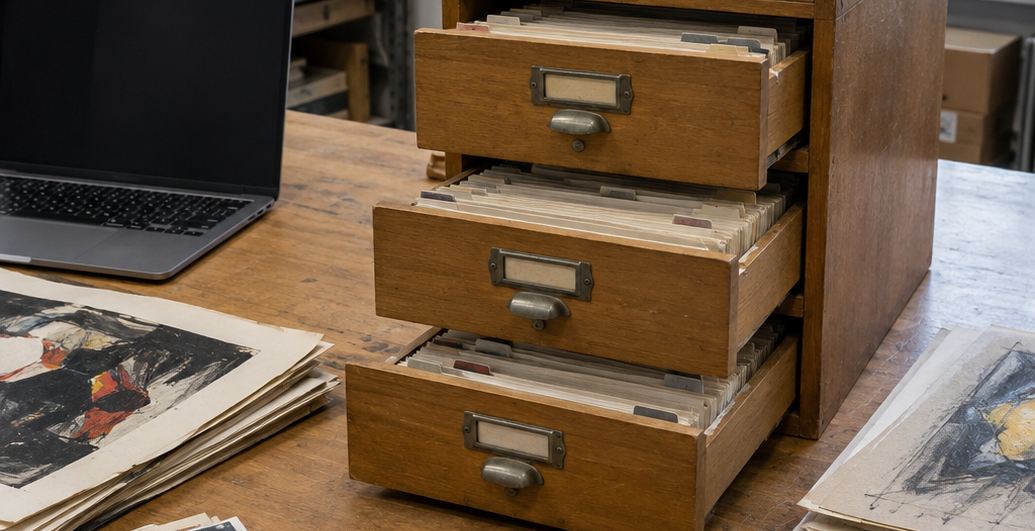
Early volunteers tried logging holdings straight into an open-source relational collection database on a donated laptop. Eleven weeks, more or less, disappeared into schema arguments and broken software updates. The team abandoned digital entry and built a three-drawer physical card catalog instead, one that three people can update simultaneously without training.
The paper index does double duty. It is a permanent finding aid in its own right, and it gives any future digitization project a clean pre-ingestion map, with authority names and folder locations already reconciled.
The three card types
All cards use 3-by-5-inch, 110-pound index stock.
- Artist Authority cards (green-banded). One card per creator, with name variants, collectives, and every folder code where that person appears.
- Chronological Programming cards (buff). Filed by gallery season, these track Big Orbit exhibitions and Soundlab programming blocks, listing participants and folder codes for each event.
- Box-and-Folder Location cards (white). One per folder, recording its code, bracketed date range, and an item count by format.
A match made three folders apart
Folder BOG-B07-F03 held an unsigned charcoal wiring diagram for a four-channel acoustic installation. No name, no date, only speaker positions and a sketch of the room. Because the box order had been preserved, processors kept reading forward and found a dated review in a local weekly three folders deeper, in BOG-B07-F06. The room dimensions in the diagram matched the space described in the review, and the review named the artist.
The match took two card entries to make permanent: a line on that artist's green Authority card pointing to F03, and a cross-reference on the buff Programming card for that season. An alphabetized box would have separated those two documents for good.
Setting Up the Table for Your First Ten Folders
Be clear about what this system delivers. Folder-level graphite numbering and three-card indexing give you box-level intellectual control over dry DIY ephemera. They stop short of item-level digital metadata, and they do not touch conservation treatment for damp, mold-active magnetic tape or film. That boundary is deliberate, because it keeps the work finishable by volunteers.
The table workflow also enforces a strict separation between inventory and identification. Without it, a first-time processor can burn an entire four-hour session chasing one obscure sound artist through University at Buffalo exhibition records and never finish a folder.
Inventory Before Identity
Open no reference material until every folder in the batch has a physical description. Research comes in the next session.
Start now. Clear a flat table of about 36 by 60 inches and pull ten unlabeled folders from the front of a single transfer box. Number their tabs 01 through 10 along the top-right edge with a #2 graphite pencil. Then spend the next 25 to 35 minutes filling out one white location card per folder, each with a single-sentence physical description and an item tally by format, such as "4 silver gelatin prints, 1 folded handbill, 6 slides." Do not try to name a single artist until the tenth card is written.