Who Actually Walks Into an Experimental Gallery After 8 P.M.?
Who actually enters a Western New York experimental space after the wine-and-cheese reception crowd leaves at 8 p.m.?
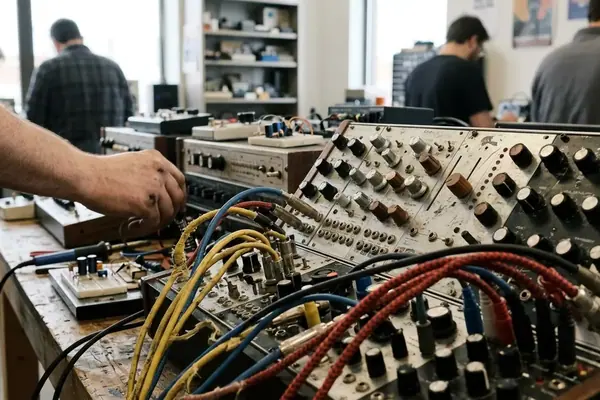
The late-shift record at Big Orbit Gallery and Soundlab points toward a mixed audience: people arriving from another opening, listeners waiting for a sound performance, students sharing rides, and neighbors curious about an illuminated doorway. Their arrival unsettles the curatorial picture of an invited audience assembled around a single exhibition. Along Essex Street and the Pearl-Main corridor, the street helped shape the room.
Front-desk shift logs spanning 1998 to 2007 provide the frame for this account. These observations concern non-commercial, artist-run spaces with small operating budgets; museum galas, with ticketing and dedicated security, followed different arrangements. Even within this narrower setting, a desk record captures arrivals more readily than motives.
The staffing problem emerged early. Curatorial teams initially treated the end of the reception as the end of the consequential evening, keeping the desk staffed only until around 8:30 p.m. Cross-town sound programming brought another wave of visitors later. Keeping someone at the door until midnight became part of presenting the work.
That second audience also encountered a change in admission. A free visual-art reception could give way to an audio performance with a suggested donation. A clear explanation at the card table helped visitors understand what was beginning and whether they could stay. The threshold carried a curatorial responsibility of its own.
The 9 P.M. Drift Between Hallwalls and Essex Street
An opening that ended around 8 or 9 p.m. could become the beginning of another venue’s evening. On overlapping nights, audiences moved between Hallwalls Contemporary Arts Center, other exhibition spaces, and Big Orbit Gallery. A conversation beside a painting could continue in a car, then resume beside a sound installation.
This circulation gave experimental work an audience beyond its usual followers. Someone who had come out for visual art might encounter a noise set because a friend knew the doors on Essex Street remained open. The encounter carried no promise of immediate comprehension. It did offer time to listen, watch other listeners, and discover how the work occupied the room.
Postcards Needed Phone Calls
Behind that apparent spontaneity sat practical coordination. Programmers used landline calls before monthly postcard mailers went to print, staggering audio starts to leave room for travel and lingering. Informal carpools carried non-driving students and visiting artists between venues. Hand-stamped re-entry marks let people step outside without renegotiating admission.
Buffalo’s interdisciplinary exchange depended on these small agreements. A shared evening worked when the next performance started late enough for the previous audience to arrive, and when someone knew where to send them. Formal institutional publicity could announce an event; word-of-mouth explained how to make the evening fit together.
The distinction matters when preserving this history. An exhibition announcement and a performance postcard may look like separate records. Read together, their start times reveal an intended route through the city. Preserving those schedules alongside desk notes helps retain the relationship between programs, rather than reducing each event to an isolated title and date.
Lake-Effect Snow and the Last Outbound Bus
A long performance asks for time. In Buffalo after dark, it also asks whether the listener can get home.
Night bus timetables and sudden lake-effect snow made duration a practical constraint. A visitor dependent on NFTA Metro Bus could appreciate a four-hour performance and still leave before its conclusion. The empty space they left behind recorded a transport decision, not necessarily a judgment about the work.
Notes from November 2001 describe the consequence plainly: organizers abandoned a four-act drone format after consecutive winter shows lost their audiences to the last reliable bus. Performers continued into an emptied room. Extending the bill had exceeded the audience’s available evening.
Cold could also bring people inside. The shelter walk-in, whether a neighbor or someone waiting for transit, entered first for warmth and then encountered a video installation. Once settled, that visitor could become an attentive critic, responding to pacing, repetition, or sound without the vocabulary of an opening reception. Desk staff needed to leave room for that response.
When the Heater Competed With the Work
Inside a converted industrial space, warmth created another negotiation. Overhead gas heaters generated fan noise capable of masking quiet improvised and electroacoustic passages. Volunteers switched the heat off during performances and restored it between sets. An intermission therefore served the building as well as the audience.
These choices pressed on volunteer labor and small budgets. Someone had to watch the door, explain admission, monitor the room, and manage the heating cycle. Keeping an exhibition venue usable after dark required attention to bodies as well as artworks.
Keeping Western New York Venues Usable After Dark
Contemporary programmers can build that attention into the running order. Start with the journey home, then work backward through the final set, the intermission, and the welcome at the entrance.
- Check the evening’s actual transit connections. Set the headliner’s finish against current bus and rail departures, allowing time to reach the stop. Publish an expected finish alongside the start time.
- Make the threshold readable from the street. Keep the entrance visibly lit and identify whether an exhibition, performance, or changeover is underway. Place donation information where visitors can read it without blocking the doorway.
- Give arrivals somewhere warm to settle. Seat people near safe, usable heat sources and keep circulation routes clear. A lit reading table near the entrance offers a low-pressure place to begin.
- Practice a plain-language welcome. Desk staff can explain what is happening, where visitors may sit, and when the next set begins. A short context sheet gives unfamiliar listeners a way into the work without requiring specialist vocabulary.
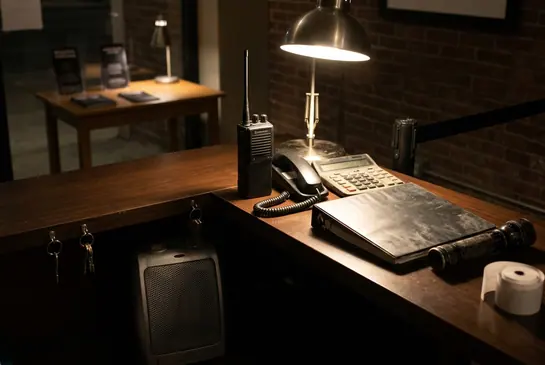
Earlier desk adjustments offer a useful precedent: volunteers moved the admission and zine table away from the steel vestibule toward the radiator banks and replaced formal binders with single-page context sheets. Visitors could warm up before discussing a donation.
At Big Orbit’s Essex Street warehouse, January moisture could freeze the electric door buzzer solid. A volunteer then sat in a coat beside the drafty threshold, monitoring the heavy steel door and holding access open with a two-inch wooden wedge. An experimental sound piece’s audience could depend on that small piece of wood and the person willing to stay beside it.