A trained live engineer walks into a room and starts hunting for problems. Ring out the monitors, notch the resonant peaks, smooth the midrange until the vocal sits politely above the guitars. Those reflexes serve a rock club beautifully. Carry them into an experimental noise set and they will quietly dismantle the piece the artist spent nearly six months building.
Quick Nav
- Why Rock-Club Reflexes Collapse in a Concrete Room
- Feedback as a Lead Instrument
- Two Blinks From the Door: Cues Without a Setlist
- Hearing Density Where the Downbeat Used to Be
- Protect the Amps, Leave the EQ Alone
Why Rock-Club Reflexes Collapse in a Concrete Room
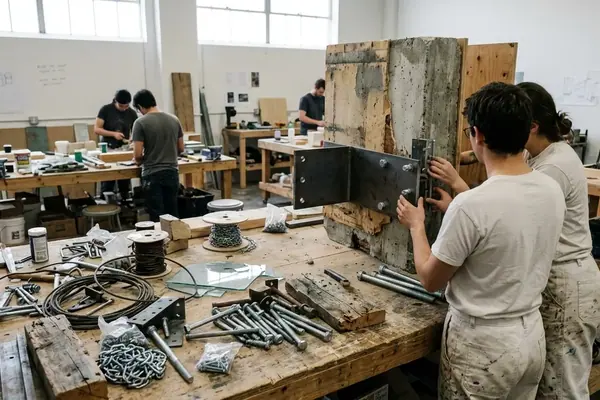
Soundlab in February was a strange teacher. The performance floor ran roughly 2,500 square feet of industrial space with exposed concrete on the long walls, and when outdoor temperatures dropped below zero the indoor humidity fell with them. Dry air changes how high frequencies travel. The same room that sounded merely bright in October turned glassy and ruthless by January, with reflections off bare concrete arriving fast and undamped.
The habit that survived all three winters was the simplest one: walk the perimeter during soundcheck. Not stand at the mix position with a measurement mic, but physically walk it, ear turned toward each wall, listening for where the slap builds and where the low end piles up in a corner. A room map built on foot is cruder than a sweep, and it is also faster, which matters when five acts are loading in behind each other.
The hardest decision came in the 2kHz to 4kHz band. Every instinct says scoop it. That region carries the abrasion, the sandpaper edge, the part of a harsh noise set that makes an audience physically uncomfortable. It is also, for most of these artists, the entire point. Leaving those frequencies un-EQ'd on the mains felt negligent for about two weeks and then stopped feeling like anything at all.
The 3kHz Temptation
Pulling a broad notch out of the upper midrange will make any noise set easier to stand in front of. It will also sand off the exact texture the performer spent their pedal chain building. If the harshness is uncomfortable, that discomfort is usually authored. Ask before you treat it as a fault.
Three winters in one concrete room is a narrow evidence base. A carpeted club with drywall and a low ceiling would argue for entirely different choices, and the reflection map described here does not transfer.
Feedback as a Lead Instrument
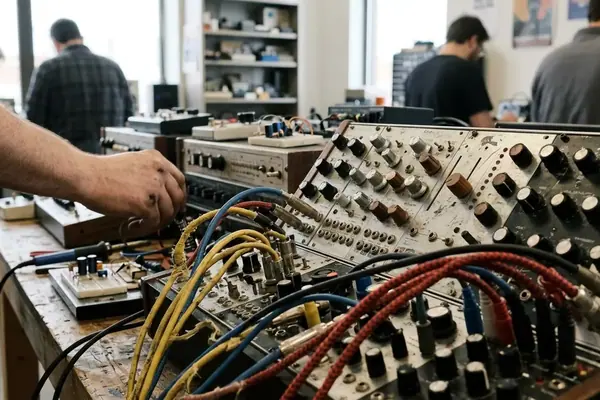
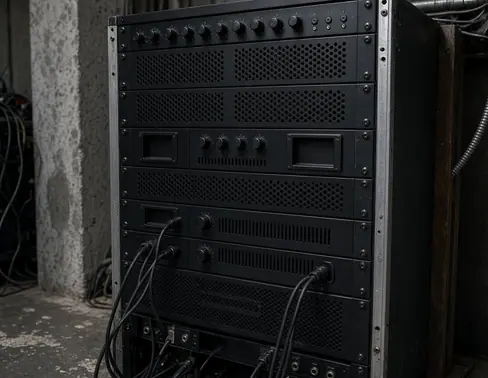
The equipment reality in a volunteer-run live-art program is blunt. Monitors blow. Channels overload. The PA is older than most of the people operating it, and the amplifier rack has opinions about sustained low frequency content that it expresses by shutting itself down.
Early on I treated feedback as a defect and gated the vocal mics aggressively between sets to kill resonant loops before they built. By the second winter that approach was gone entirely. Performers were using the open mic bleed deliberately, letting the room excite sympathetic resonance inside their pedal chains. Every gate I closed was a door slammed on an instrument.
What replaced it was a narrower, more physical kind of attention. During peak swells the main faders lived between -3dB and +2dB, small corrections riding the energy of the piece rather than flattening it. The real monitoring happened at the amplifier rack, watching for clipping that would push the power amps toward thermal shutdown during sustained feedback. The thermal shutdown threshold of those aging amplifiers, particularly during long 40Hz drone passages, became the one hard boundary in an otherwise permissive night.
Riding the edge of feedback is a two-handed skill. One hand stays near the master, the other near the channel that is about to go. The ear learns to hear the half-second of build before a loop locks in, the way a sailor reads a gust on the water before it arrives at the boat. Cut too early and you have censored a gesture. Cut too late and a monitor driver pays for it.
Two Blinks From the Door: Cues Without a Setlist
The solution arrived before the problem was fully articulated: a pocket flashlight, double-flashed from the door, meaning the noise curfew is close. Radio communication is useless in an approximately 95-decibel room. Walking the floor to deliver a message costs close to ninety seconds the board cannot spare. A visual shorthand agreed on during load-in solved a logistical problem that had been quietly degrading every show.
Those nights ran bills of five to seven distinct acts inside a strict 180-minute window during public installations before local noise ordinances took effect. Nobody had a setlist. Nobody could tell you whether their piece would run four minutes or twenty-six. The door volunteers, the lighting person and the engineer were effectively running a relay with no baton and no schedule, which makes shared visual language the only infrastructure available.
Reading the room became the substitute for a cue sheet. A few patterns held up across three seasons of transitions:
- Posture at the front rail. When the first two rows shift weight from one foot to the other in unison, a dynamic change has already started that the board has not registered yet.
- The performer's shoulders. A noise artist winding toward an ending drops their shoulders and stops reaching for the pedalboard. That tell arrives roughly ten seconds before the actual stop.
- Room drift. Audience movement toward the bar during a long passage rarely means boredom; it usually means a frequency is masking something and the piece has lost its spatial depth from the back of the room.
Where the Flashlight Fails
Visual cueing collapses completely when a performer uses heavy strobe or demands total blackout. Under those conditions the only reliable option is to leave the board, step into the room and gauge it with your body. Plan for a trusted second pair of hands before the lights go out, not after.
Hearing Density Where the Downbeat Used to Be
Somewhere in the second winter the work stopped being technical survival and became listening. That shift is the real recalibration, and it is difficult to describe to engineers who have only mixed music with bars in it.
Drone forces the issue first. Sustained content hovering around 40Hz to 60Hz does not reward channel-by-channel surgery, especially when every open microphone is already bleeding into every other one. The useful move is to ride the master fader and shape macro-dynamics across the whole piece, treating the mix as a single wide object rather than a stack of sources. Tracking frequency masking across a passage running past twenty minutes with no dynamic variation teaches patience that no three-minute song ever will.
The habits that came out of that are portable:
- Listen for the gap, not the peak. In dense material, the information lives in whatever momentarily stops masking something else.
- Track spatial position before timbre. Where a sound sits in the room tells you more about the artist's intent than its tonal character does.
- Give the piece ten minutes before deciding anything. Texture reveals structure slowly, and early intervention almost always flattens it.
This translates directly to the gallery floor. Walking through an installation at Big Orbit's exhibition venue, or through the programming at Hallwalls Contemporary Art Center, the same attention applies: surface density, duration, what sits in front of what. Buffalo's experimental scene has always rewarded viewers and listeners who stop looking for a chorus. The city's gallery criticism, including the long-running exhibition coverage of Buffalo News art critic Richard Huntington, consistently treated that patience as a basic requirement rather than a specialist taste.
Protect the Amps, Leave the EQ Alone
Here is the position worth defending: stop trying to fix the mix. Adopt damage control as the whole philosophy and commit to it before the first act loads in.
In practice that means setting gain structure during soundcheck, establishing a continuous SPL in the range of 95 to 98 decibels at the mix position, keeping the room clear of the 100-plus decibel territory where immediate hearing damage begins, and then refusing to touch the channel EQs once the set starts. The operational work shifts to watching amplifier temperature and listening for the moment the PA is genuinely in danger. Everything else belongs to the artist.
What the Board Owes the Artist
Two things, in order: a system that survives the set, and a signal path that does not editorialize. Anything beyond that is the engineer composing over someone else's work without being asked.
Engineers trained in studio ideals will read this as abdication. It is the opposite. Facilitating the acoustic reality of a cold concrete room, with its dry air and its unforgiving reflections, requires sharper judgment than imposing a studio template on it, because every correction you decline has to be a decision rather than an oversight. Anyone working in live avant-garde programming should make that trade deliberately and early. Protect the amplifiers, protect the audience's hearing, protect the artist's intent, and leave the rest of the night alone.