Quick Nav
- When Did the Pearl Street Floors Fall So Quiet?
- Brick Slapback and the Seven-Second Silence
- Bowed Cymbals, Hydrophones and the Bar-Ice Freeze
- Amber Lamps, Floor Rigs and Packed Bodies
When Did the Pearl Street Floors Fall So Quiet?
When does respectful silence stop protecting an experimental performance and start suffocating it? Anyone who stood in Soundlab's 110 Pearl Street room between 2006 and 2011 had a chance to watch that question play out with their own eyes, usually around the second act of a harsh-electronics bill.
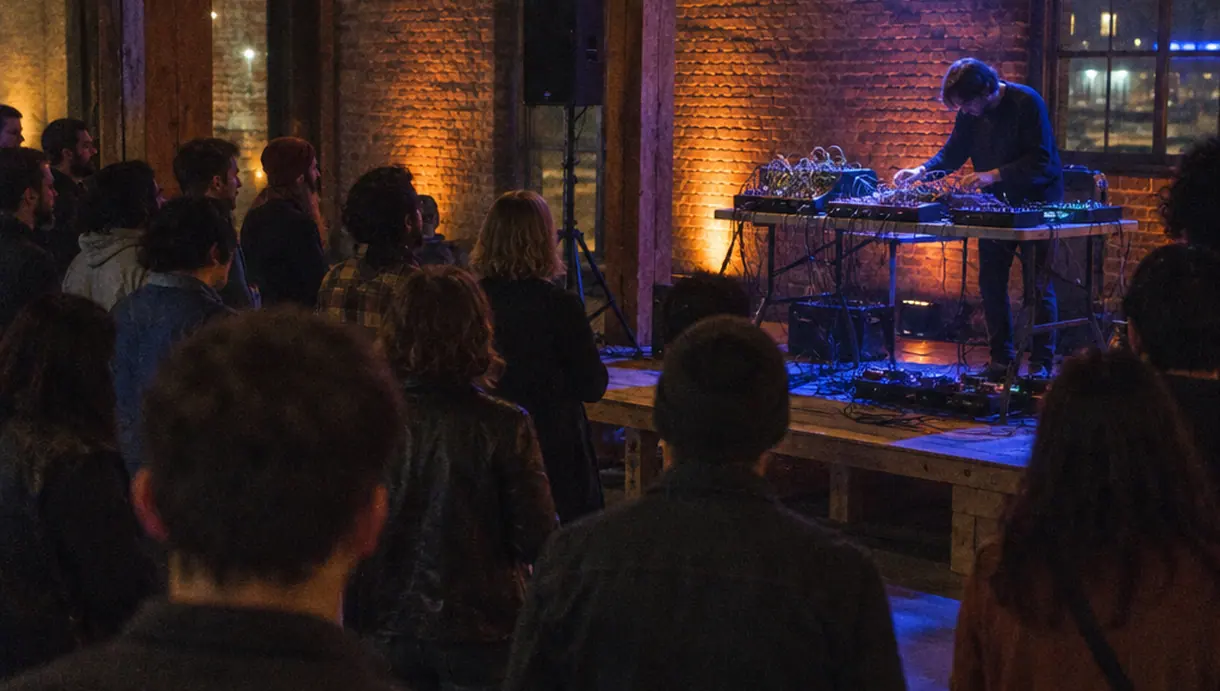
The room changed shape in a recognizable way. A touring noise artist would set up a folding table on the poured-concrete floor, and the crowd would retreat. SUNY Buffalo media study students and gallery patrons clustered back near the bar archway with folded arms, leaving an empty 12-to-15-foot semicircle directly in front of the gear. They listened intently. They also behaved like an audience waiting for a string quartet to finish a movement so they could clap at the correct moment.
The booking staff had already tried to break this habit. They pulled improvisers and harsh-electronics acts off the elevated plywood stage and moved them onto the concrete near the center support columns, hoping to dissolve the proscenium barrier that kept people at a distance. The stage disappeared. The distance stayed.
What made the frozen crowd so striking was how much the performers themselves could absorb. Players regularly pushed through 60-cycle ground-loop hum from sharing circuits with the bar coolers, or a blown 15-inch floor monitor wedge, without losing rhythmic momentum. A dead speaker barely registered as a setback. A room full of motionless, politely silent people drained a set faster than any equipment failure, because no technician could swap in a replacement for missing human energy.
Brick Slapback and the Seven-Second Silence
The problem had an acoustic dimension before it had a social one.
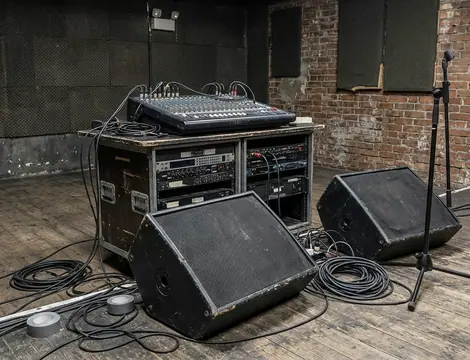
High-volume improvisation bills at Soundlab routinely ran at 102 to 108 dB SPL at the center mix position. These were sets built from contact-mic'd scrap metal, overblown tenor saxophones and daisy-chained distortion pedals, and they depended on a room that pushed back. Sound technicians who tracked resonance during these nights noticed a pattern. When the audience stood completely still and silent along the perimeter walls, slapback echo off the exposed brick muddied the low-mid frequencies. The improvisers heard their own sound returning to them smeared and late, lost their footing, and frequently cut sets short.
A moving crowd changes that feedback loop in two ways. Bodies in the center of the floor break up reflections before they reach the walls, so the performer hears something closer to the direct signal. The second effect is psychological and just as real: shifting weight, a shout over a feedback swell, someone stepping closer during a crescendo. Free jazz drummers and live-looping percussionists read that ambient friction the way a sailor reads wind. It tells them when to build and when to let the pressure drop.
The gap after the final patch cord
The clearest symptom arrived at the end. After a 22-minute continuous piece, the stretch between a performer pulling the final patch cord and the first hesitant handclaps typically ran from 4 to 7 seconds. In a room still ringing from a 105 dB wall of distortion, that silence felt enormous. The brick held the decay, the crowd held its breath out of etiquette, and when the applause finally came it was tepid and obligatory.
Twenty-two minutes of accumulated tension needs somewhere to go. A shout, a stomp, an immediate roar would let it discharge. Polite, delayed clapping severed the atmosphere and recast the whole piece, after the fact, as a recital that had simply concluded.
Watch the Back Wall
If a high-volume set starts sounding boomy and indistinct halfway through, check where the audience is standing before touching the mixing board. A crowd lined up along exposed brick turns the walls into reflectors, and no amount of EQ fully compensates.
Bowed Cymbals, Hydrophones and the Bar-Ice Freeze
Quiet had its place, and Soundlab learned exactly where that place began during the winter 2008 season.
A visiting composer performed an unamplified bowed-cymbal solo, and bottle recycling behind the bar drowned it out. The booking collective responded with a firm rule for electroacoustic and field-recording nights: a pre-set bar freeze. The ice scoop, the blender and the point-of-sale register chime all shut down before the first note. Unamplified extended-technique woodwind and micro-sound sets operated within a narrow dynamic window just 6 to 10 dB above the building's baseline HVAC and street-traffic noise floor. A single clinking bottle could consume that entire margin.
On these nights, the crowd's stillness did real acoustic work. Expecting vocal pushback and physical movement from the floor destroys a set whenever the sound source relies on unamplified room decay or micro-voltage speaker cones running below conversation volume, so listeners at a hydrophone playback were right to lock in completely.
Two kinds of stillness
The useful distinction lies in posture. Coiled stillness looks like people leaning in, edging closer to the source, holding the room's acoustic floor intact because they want to hear the overtones of a bowed cymbal fade into the HVAC hum. Passive politeness looks like the folded arms near the bar archway: silence driven by social anxiety and a fear of breaking gallery etiquette, with the body pulled away from the sound.
Both are quiet. Only one serves the work.
Mixed bills made the confusion worse. A single 150-minute evening often paired three distinct acoustic thresholds, moving from near-inaudible hydrophone recordings to full-kit free jazz within a 15-minute changeover. Audiences who had just spent shy of forty minutes trained into pin-drop focus carried that conditioning straight into a drummer's opening barrage. They stood frozen through music that wanted them moving, uncertain whether the rules had changed, and reluctant to be the first person to find out.
Amber Lamps, Floor Rigs and Packed Bodies
The fixes that actually worked at Pearl Street were environmental. Explanation failed. During the 2009 fall series, organizers printed short program handouts describing the sonic range of each act, so patrons would know whether a set invited movement or silence. The practice lasted three shows. People read the sheets under the bar light and stood even further back from the performance floor.
Light and volume did what paper could not.
Adjustments for hosts and bookers
- Sequence the bill by threshold. Avoid placing a full-kit free jazz set immediately after a hydrophone playback. Step the evening upward in density so the crowd's etiquette can shift gradually, or insert a mid-volume act as a buffer.
- Put loud acts on the floor and fragile acts where the room is quietest. The concrete floor near the center columns suited high-volume improvisers; micro-sound needs whatever position sits furthest from the bar coolers and street wall.
- Use house music as a cue. Keeping between-set music at a conversational 75 to 78 dB signals that the room is allowed to breathe and talk.
- Dim everything except the rig. Bringing the overhead track fixtures down to a single 40-watt amber work lamp over the cabling table kept listeners within four feet of the performer's gear. People drift toward the only light in the room.
- Call the bar freeze only when the dynamic window demands it. Reserve it for sets living within a few decibels of the noise floor, so the ritual keeps its meaning.
The Forty-Watt Trick
One warm lamp over the cable table outperformed every printed program note Soundlab tried. Lighting tells a crowd where to stand without asking anyone to read.
Reading a set from the floor
Listeners can match their response to what the performer is physically putting into the room. A player hunched over a laptop, coaxing faint clicks from a micro-voltage cone, is asking for coiled attention: move closer, keep still, keep your glass on the bar. A saxophonist overblowing into a contact-mic'd sheet of scrap metal at full exertion is asking for something back. Step into that empty semicircle. React when the density peaks. When the final patch cord comes out after twenty-odd minutes of noise, respond immediately instead of waiting four seconds for permission.
Gallery restraint suits plenty of exhibitions. It works badly as a default for every experimental bill in the Buffalo arts scene.
Proximity Shapes Tone
Where the crowd stands is a mixing decision. A packed center floor and an empty one produce two different sets from identical gear.
That last point is literal physics. In an untreated 1,800-square-foot brick-and-timber room like the Pearl Street space, 20 to 35 standing bodies packed near the center floor act as broadband acoustic baffles, absorbing the harsh 800 Hz to 4 kHz reflections that bounce between the parallel walls. Before anyone claps, shouts or stomps, the decision to walk forward into that 12-to-15-foot gap has already re-equalized the set.