The VHS Glow of Industrial Noise
A Soundlab performance in the late 1990s often entered the camera as a collision of partial views. A performer’s shoulder crossed the frame. Audience members blocked the stage. Light from a video monitor smeared across the image while the autofocus searched through smoke, movement, and darkness. The resulting footage carries a distinctive visual pressure: close, unstable, and continually at risk of losing its subject.
That instability began with a practical choice. Camera operators placed consumer-grade Hi8 equipment where the lens stood the best chance of surviving physical contact, even when the location offered a poor sightline. Many early recordings therefore look upward from the edge of the audience, with bodies and equipment interrupting the composition. What appears today as an expressive low-angle style originated in the material conditions of a crowded exhibition venue.
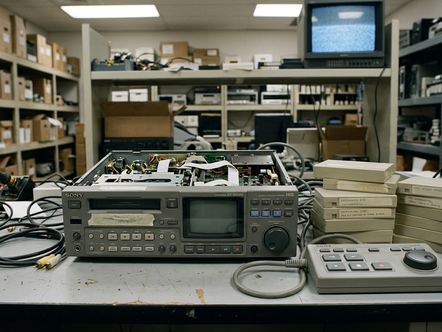
Sound required its own spatial negotiation. Microphone cables were routinely taped to ceiling beams, keeping them above the primary floor, on the order of 400 square feet, where the audience gathered. This arrangement protected connections and reduced tripping hazards, yet it also fixed the microphones at a distance from the shifting acoustic center of the performance. The recording captured the room as much as the performers: reflected frequencies, conversations near the walls, and vibrations transmitted through the building.
Consumer Hi8 tapes allowed 120 minutes in standard play mode. Operators had to judge when a performance might pause, accelerate, or exceed the remaining tape. Changing a cassette during a quiet transition could destroy the transition; waiting too long risked losing the ending. These decisions gave the document an uncredited editor before anyone reviewed the footage.
The Protected Lens
The obstructed frame should be read as evidence of proximity. Camera safety, audience density, and limited floor space shaped the image before aesthetic preference entered the equation.
The magnetic tape then introduced a slower form of instability. Each cassette held a site-specific event on a medium vulnerable to storage temperature, mechanical wear, and oxide loss. The performance had already vanished by the time the tape left the camera; the archive inherited a fragile approximation whose hiss, interrupted views, and saturated levels became part of Soundlab’s historical texture.
The Tension Between Event and Archive
Avant-garde performance frequently derives its force from impermanence. Duration, physical risk, audience movement, and improvisation belong to a single encounter. Recording extends that encounter into another context, where viewers can stop, repeat, compare, and classify material that originally moved in one direction through time.
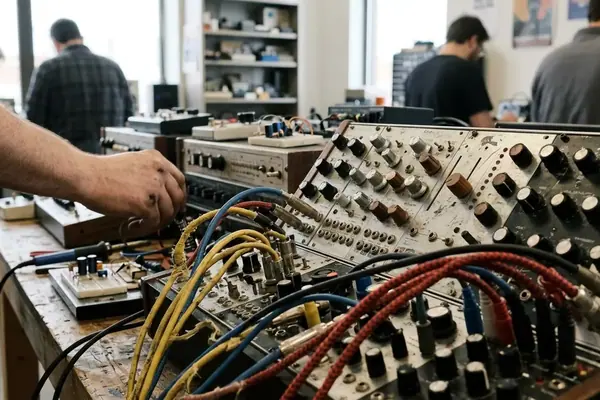
The camera also changed the room it sought to preserve. Performers could turn toward it, avoid it, or incorporate its red recording light into the evening’s visual field. Audience members adjusted their positions around tripods and cables. A microphone placed near the mixing board privileged the engineered signal, while one suspended above the floor registered conversation, footfall, and bodies absorbing reflected sound. Every placement produced a distinct account of the same night.
Surviving cassettes make those interventions audible. Sets lasting 45 to 60 minutes frequently contain a hard cut around the 30-minute mark, corresponding to the physical flip of a standard Type II cassette. That mechanical interruption can divide a sustained drone or remove the pivot of an improvisation. Low-frequency feedback loops also overwhelmed the venue’s 12-channel mixing board, driving recording levels into sustained distortion. In this repertoire, distortion could originate with the composition, the room, the board, or all three at once.
Cataloging Interference
The collection’s archival taxonomy addresses that ambiguity through acoustic interference. Recordings are categorized by the presence of crowd noise, equipment failure, or structural vibration rather than treated solely as transparent containers for named works. This approach places the conditions of capture beside performer, date, and format. It also prevents a damaged signal from being mistaken automatically for poor documentation when overload may have been central to the event.
Attempts to apply standard noise-reduction algorithms to industrial music recordings frequently erased intentional high-frequency distortion. A technically cleaner file could therefore offer a less faithful account. The useful distinction lies between noises generated by media decay and abrasive frequencies deliberately produced in the room, though the two sometimes occupy the same spectral territory.
The Thirty-Minute Cut
A cassette flip marks the agency of the recorder. It belongs in the catalog record because the interruption affects how later listeners interpret pace, continuity, and structure.
Patterns of survival reveal a second editorial layer. Scheduled showcases with an available operator entered the archive more readily than spontaneous collaborations, informal rehearsals, or performances that began after the recording stock ran out. Absence from the collection establishes no hierarchy of importance. It identifies where documentation practice met the practical limits of labor, attention, and equipment.
From Cassette Hiss to Digital Clarity
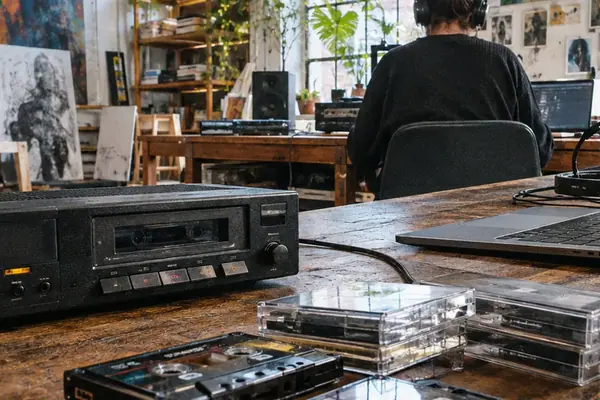
Soundlab documentation moved through several recording regimes: analog cassette, Hi8, MiniDV, Digital Audio Tape, and early digital capture. Each format promised an improvement in some area while adding a new dependency. Cassette tolerated rough handling but divided long sets at the tape flip. MiniDV combined image and sound in a compact carrier, then made reliable timecode essential. DAT offered detailed audio while relying on narrow tape, calibrated transports, and media that could become difficult to play.
Preparing a Transfer
- Inspect the carrier. Archivists check the shell, tape pack, labels, and visible contamination before placing media in a deck.
- Stabilize vulnerable stock. DAT media from 1999–2001 exhibited sticky-shed syndrome. The documented workflow used a 12- to 24-hour baking process at 130°F before playback.
- Clean during capture. Playback heads require isopropyl-alcohol cleaning after every 90 to 120 minutes of transfer to limit oxide buildup.
- Capture with restraint. Early digital transfers were standardized at 24-bit/48kHz, balancing signal fidelity against the storage constraints of early-2010s hard drives.
- Retain the source character. Engineers distinguish transport noise and deterioration from intentional distortion before applying restoration tools.
MiniDV exposed the weakness of automation. Initial preservation work attempted batch processing through automated capture software. After 14 to 18 days, timecode dropouts produced severe audio desynchronization, and the method was abandoned. Real-time review demanded more labor, but it allowed an operator to catch drift, repeated frames, and interrupted sound while the original cassette remained available for another pass.
Physical storage history further complicates access. Magnetic media kept in the climate-controlled gallery office survived differently from tapes held near the uninsulated loading dock. Heat fluctuation, moisture, dust, and repeated playback left distinct traces on carriers that may have begun as identical stock. Any analysis of the Soundlab archive remains bounded by media survival and the continuing physical decay of magnetic tape.
Citations
The Library of Congress outlines handling, storage, and environmental principles in its magnetic media preservation standards. Those principles provide a useful baseline, while individual carriers still require inspection before playback.
Digital clarity can create the impression that a recording has escaped its object history. The opposite is often true. A stable file carries decisions about deck alignment, head cleaning, sample rate, channel balance, and tolerated noise. Preservation makes those decisions traceable so future listeners can distinguish the captured event from later intervention.
Curating the Avant-Garde Legacy
The surviving recording becomes a gate through which historical attention passes. A night preserved on soundboard audio and audience-perspective video can support close analysis of gesture, staging, and spatial response. An equally consequential mid-week collaboration represented only by a booking-ledger entry remains harder to exhibit, teach, or cite. Documentation density gradually acquires the appearance of cultural importance.
Cross-referencing surviving media with physical booking ledgers reveals a pronounced bias toward weekend showcases. Mid-week experimental residencies appear far less often in the recordings. One catch narrows the comparison: surviving audio can be matched reliably with historical venue calendars only for 1998–2004 because earlier paper booking ledgers were lost to basement water damage.
Building a Composite Record
Curatorial selection for the digital exhibition prioritized nights where soundboard audio and audience-perspective video both survived. The paired sources permit a composite reconstruction. Board audio clarifies the routed signal, while the camera microphone locates that signal within applause, conversation, structural vibration, and the reverberant gallery. Neither source contains the complete event; together they make the recording’s spatial differences available for study.
More than 300 hours of digitized material required manual metadata tagging to identify uncredited guest performers. Names spoken from the stage, handwritten labels, visual recognition, and sequence within a booked program could help establish identity. Uncertain identifications remain meaningful metadata because they expose the distance between a live community’s shared knowledge and the archive’s need for explicit description.
- Carrier-level records document format, condition, duration, and transfer history.
- Event-level records connect dates, performers, program order, and venue information.
- Interference terms identify crowd sound, equipment failure, feedback, and structural vibration.
- Relationship fields connect alternate recordings of the same performance.
Weekend Shadow
Heavily documented showcases can overshadow less formal work. Booking records and unresolved performer fields keep those gaps visible instead of converting silence into certainty.
For contemporary art history, the archive’s value lies partly in this legible incompleteness. It offers material for studying Buffalo’s post-industrial acoustics, artist networks, recording practice, and the overlap between exhibition venue and music incubator. It also shows how archival taxonomy participates in interpretation: the chosen fields determine whether future research sees a list of performers, a history of media, or a changing relationship between sound and space.
Listening to the Room Tone
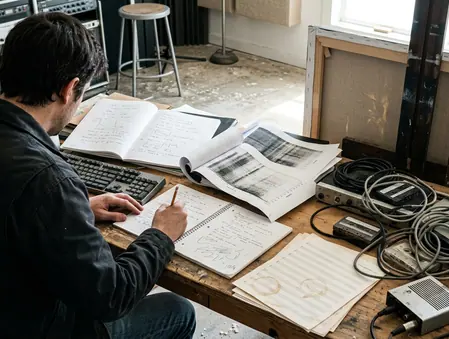
Room tone usually occupies the edge of attention. At Soundlab, it holds architectural information. Spectral analysis reveals a consistent 250Hz resonance associated with the exposed brick walls and concrete flooring. The frequency sits beneath performances as a recurring spatial signature, altered by audience density and amplification yet still attached to the room.
Restoration engineers retained the 60Hz electrical hum from the aging PA system during mastering. Removing it would have quieted the file while stripping away part of the venue’s acoustic identity. The hum establishes scale and anticipation during pauses. It continues when a performer stops, when someone crosses the floor, and when the audience waits for the next signal.
That decision separates preservation from cosmetic repair. The goal is not to make a late-1990s industrial performance resemble a contemporary studio recording, but to render its surviving evidence intelligible. Cassette hiss, electrical hum, intentional distortion, and damaged oxide demand separate judgments even when they arrive at the listener as one dense field.
In a modern transfer studio, an archivist seats a prepared DAT cassette in the deck and opens the 24-bit/48kHz capture file on the monitor. The meters rise before the music begins. A ventilation fan turns somewhere beyond the microphones; shoes shift against concrete; the PA holds its steady 60Hz tone. Then the exposed-brick room answers at 250Hz, a performer touches the first control, and a Buffalo night begins again.