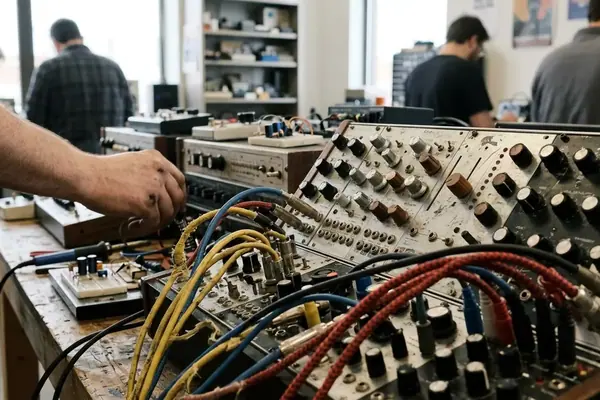
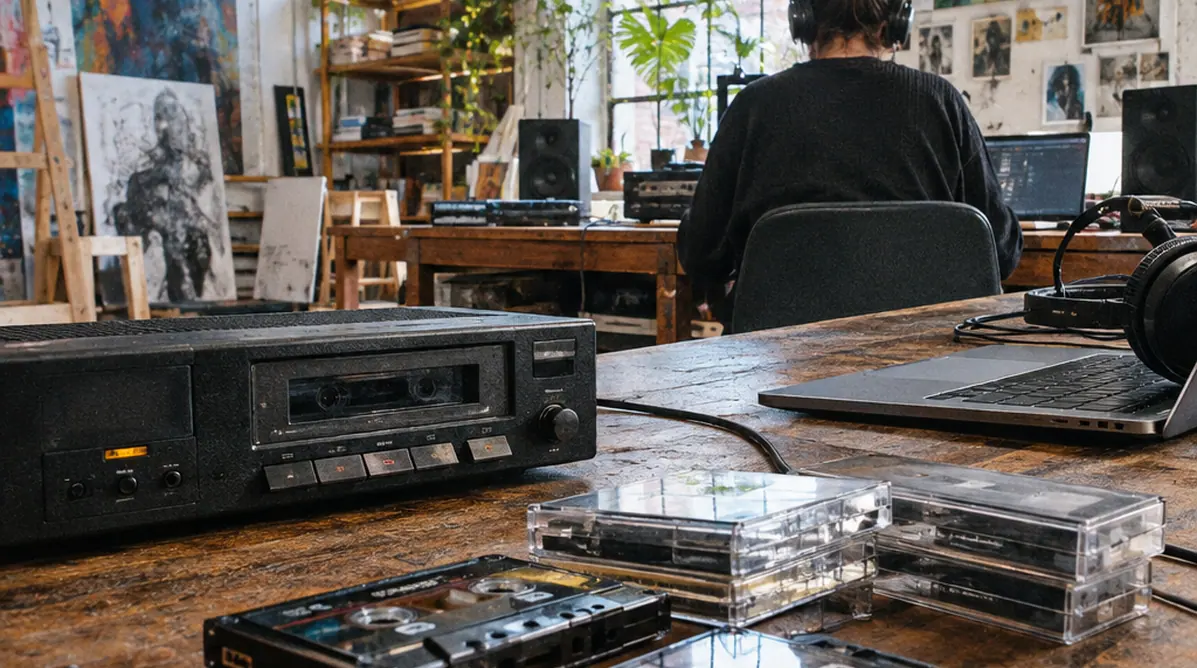
Somewhere in a basement in Allentown there is a shoebox of unlabeled Type I cassettes. One of them may hold the only surviving document of a Soundlab set that about thirty people attended and nobody recorded twice. The audio is still there, magnetically speaking. What is failing is the glue.
What Is Actually Rotting Inside a 1998 Cassette Shell
Magnetic tape degradation is a specific chemical event: the polyurethane binder that fixes magnetic particles to the polyester base layer absorbs moisture and breaks down, a reaction called hydrolysis. Once the binder loses cohesion, oxide sheds onto the tape path during playback, and the particles carrying the performance simply leave the tape.
The trigger is ambient humidity. Hydrolysis accelerates sharply when relative humidity stays above 45% over sustained periods, which describes the average Western New York basement between June and September with uncomfortable accuracy. Type I ferric oxide cassettes manufactured between 1990 and 1998 — the exact stock that circulated through Buffalo's experimental scene during its densest years, sit squarely in the vulnerable population.
This produces an awkward tension for anyone working on community audio. Institutional archives have climate control, calibrated transports and trained operators. The recordings themselves, though, are overwhelmingly held privately: in closets, in milk crates, in the possession of people who played the show rather than documented it. Waiting for perfect conditions means waiting past the point where playback is possible at all.
The Twenty Minutes of Deck Maintenance That Decide Everything
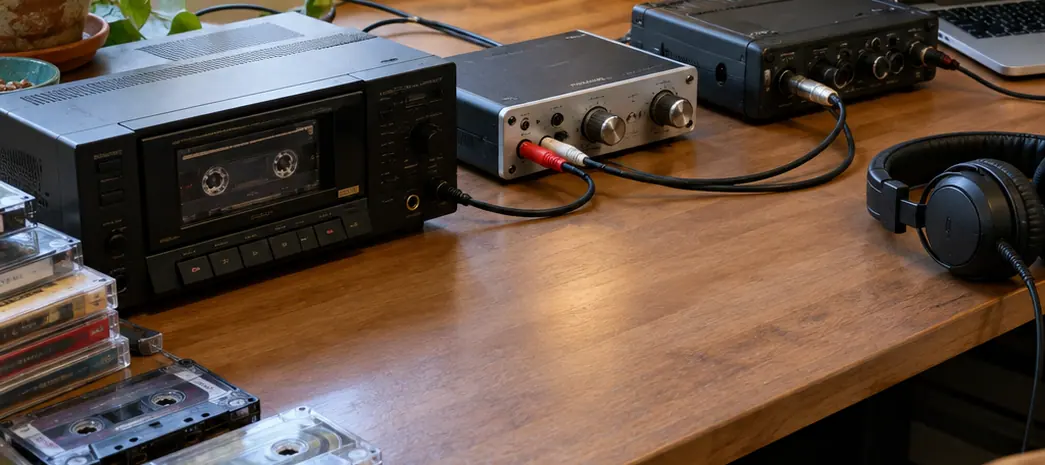
Consider a typical case: a collector brings in a two-deck Nakamichi that has not been opened since roughly 2004. The tapes are irreplaceable. Pressing play immediately is a strong temptation. The correct move is to spend somewhere near twenty minutes on the transport first, because a dirty capstan will do more damage to a shedding tape than a decade of storage.
The cleaning sequence is narrow and unglamorous. Use 99% anhydrous isopropyl alcohol applied with chamois swabs rather than cotton; cotton leaves lint across a tape path only around 0.15 inches wide, and lint on a pinch roller becomes a tracking error on every transfer that follows. Work through the capstan, the pinch roller, then the heads, and let the alcohol flash off completely before loading anything.
Demagnetization comes next. Residual magnetism in the heads erases high-frequency content on contact, which is catastrophic for material built out of cymbal wash, circuit noise and feedback harmonics. Pass the demagnetizing wand over the heads at roughly 1 inch, then withdraw it slowly to a distance of 3 feet before switching it off. Powering down the wand near the deck defeats the entire procedure.
Sticky-Shed Stop Signal
Azimuth adjustment on a well-maintained consumer deck is a legitimate stopgap for community-held media, and often the only realistic one. It is not a substitute for a professional archival transport with time-base correction. Tapes showing severe sticky-shed syndrome — audible squeal, visible residue on the guides — require professional thermal baking before any playback attempt. A consumer transport will strip the oxide layer and the recording ends there.
Azimuth, Briefly
Home-dubbed cassettes were rarely recorded on aligned machines. Adjusting the head azimuth screw while monitoring high-frequency content in mono usually recovers a surprising amount of top end from a tape that sounded muffled on first pass. Make the adjustment on a test pass with a less precious tape, then transfer.
Why Harsh Noise Breaks Your Level Meters
Capture at a minimum of 24-bit/48kHz. The bit depth matters more than the sample rate here, because it buys headroom, and headroom is the entire problem with experimental material.
An early round of transfers from this repertoire used automated clipping limiters to tame the violent dynamic shifts typical of harsh noise sets. The results were technically clean and artistically wrong: the limiters were compressing intentional amplifier feedback, smoothing the exact gesture the performer had spent the set building. That workflow was discarded. The replacement is a flat transfer with peaks landing between -6dBFS and -12dBFS, leaving room for a sudden burst without clipping and leaving the artist's dynamics intact.
Resist noise reduction and equalization at the transfer stage entirely. Tape hiss, hum and distortion are frequently part of the composition rather than damage to it, and a de-hisser cannot tell the difference. The archival principle of capturing a flat, unvarnished transfer exists precisely because future listeners may want to hear what you would have removed. Make derivative files for listening; keep the flat master untouched.
Reading a Gig Program as a Cataloguing Tool
A pristine 24-bit file of an unidentified performance has limited archival value. Without date, personnel and venue, it enters a collection as an orphan and stays there.
The recovery method is documentary cross-reference. Surviving Big Orbit Gallery and Soundlab gig programs spanning September 1996 to May 2001 provide dated lineups; matching a tape's running order and set length against those programs will often resolve an unlabeled cassette to a single evening. Printed exhibition coverage in the Buffalo News, where the paper's art critic Richard Huntington reviewed the gallery's shows, supplies another dating anchor when a program is missing. Where a tape's B-side sequence matches a program's billing order, the identification generally holds.
One Naming Convention, Applied Without Exception
Use YYYYMMDD_ArtistName_Venue_SourceMedium, as in 19981024_Artist_Soundlab_Cassette.wav. Front-loading the ISO date makes chronological sorting automatic, and naming the source medium keeps a cassette transfer distinguishable from a later CD-R dub of the same set. Inconsistent naming is the most common reason otherwise excellent community transfers never get ingested into a larger archive.
Honest Gaps
Some tapes will not resolve. Programs are incomplete, handwriting on J-cards is ambiguous, and a portion of this material will enter the archive dated only to a season. Record the uncertainty in the metadata rather than guessing a date.
Where the Tape Goes After the Transfer
Package deposits simply: uncompressed WAV masters alongside a UTF-8 encoded CSV metadata sheet, one row per file, with columns for date, artist, venue, source medium, transfer date, deck used and confidence level on the identification. Plain text survives software migrations that proprietary catalog formats do not.
Then keep the cassette. Store it upright, fully wound onto one hub, in a stable dry room rather than a basement, away from speakers and transformers. The physical object still carries evidence the audio file cannot: handwriting, dubbing generation, the residue of whoever passed it along.
Here is the number that should govern the schedule. A standard ferric oxide cassette pressed in the 1990s has an estimated optimal lifespan of 10 to 30 years. The Soundlab programs run to May 2001. Every one of those tapes is already past the low end of that estimate, and the binder is not waiting for anyone's convenience.