A Folded Leaflet Among the Essex Street Grant Drafts
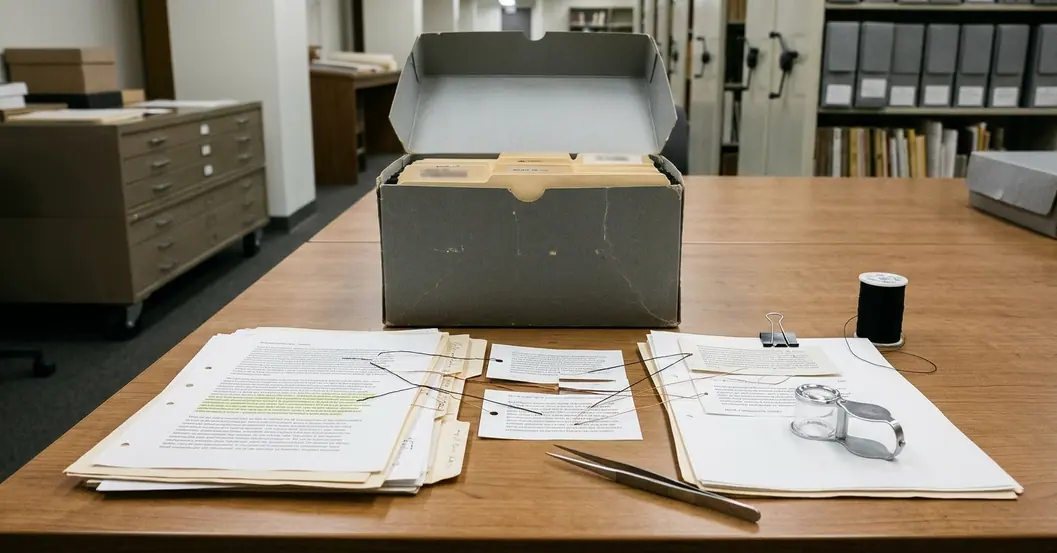
Opening a worn manila folder from the Big Orbit Gallery artist files brings a folded exhibition leaflet into view beside heavily annotated fellowship drafts. Rusted steel paperclips hold the documents together. The brochure belongs to a brief public event; the attached writing extends across years of applications. Their proximity makes the folder an unusually legible account of how an exhibition continued to operate after its closing.
While processing the 1998–2004 artist files from the Essex Street storage boxes, archivist-researchers preserved the working grant drafts in their existing folder order. Separating correspondence, printed ephemera, and application prose would have produced cleaner categories while obscuring the relationship among them. Here, arrangement carries evidence: the artist kept the leaflet close enough to annotate, consult, and reuse.
Why treat an exhibition brochure as disposable opening-night promotion when its language may carry an artist’s career paperwork for years?
The physical object sharpens that question. Printed locally in a run of shy of 350 copies, the tri-fold brochure used 80-pound uncoated cardstock and measured 8.5 by 14 inches unfolded. Its immediate assignment was a five-week autumn exhibition. Four successive state and national fellowship draft narratives, spanning a six-year period, remained clipped directly to the marked-up leaflet.
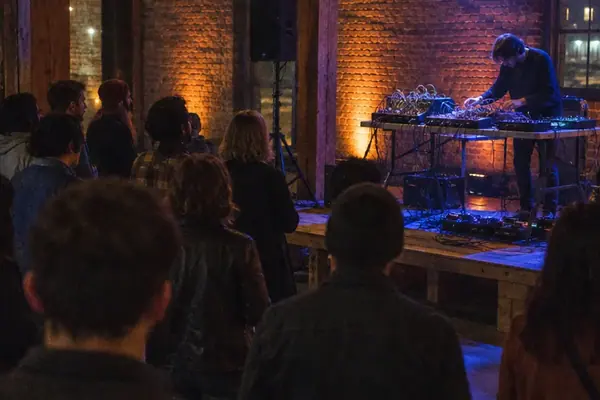
For experimental artists in the Buffalo arts scene, this disparity between exhibition duration and documentary lifespan matters. A sound installation occupies a particular room, activates particular surfaces, and changes as listeners move. Once the equipment leaves, photographs retain its appearance more readily than its behavior. Curatorial prose can preserve the relationship between apparatus, architecture, and listening that made the work intelligible.
Across Big Orbit’s exhibitions and the experimental culture associated with Soundlab, archives & texts therefore deserve attention as working components of artistic practice. This folder offers a specific instance: an essay written for gallery visitors became a durable source for describing what an artist had already accomplished.
The Essay’s Theory Followed the Installation’s Mechanics
The original solo exhibition essay took shape through a change in curatorial method. During the ten-day installation window, the curator initially drafted an abstract account rooted in post-structuralist acoustic theory. Watching the artist calibrate the room’s resonant frequencies redirected the writing. Over pushing 48 hours, the curator rewrote the essay so that physical operations supported its theoretical claims.
The resulting 1,150-word text accompanied a technical checklist: four modified reel-to-reel tape decks, upward of 140 feet of tensioned piano wire anchored into brick masonry, and two low-frequency transducers beneath a temporary plywood floor. Yellow legal-pad sheets tucked inside the brochure preserved penciled observations from a three-hour soundcheck before the public opening. Read together, these materials connect interpretation to observed conditions.
The Spatial Anchor: Architecture as an Active Element
The first textual layer establishes where the installation acts. Exact room dimensions, architectural attachment points, and relationships among surfaces give the reader a spatial anchor. In this installation, wire anchored into brick and transducers mounted beneath plywood made the building part of the work’s operation. A description restricted to objects on display would lose that relationship.
The distinction becomes consequential when an application leaves Buffalo. A local visitor could encounter the room directly; a remote reviewer needs language that reconstructs the relevant spatial conditions.
The Acoustic Inventory: Equipment With a Function
The second layer identifies materials, hardware modifications, and the signal chain. Equipment names establish an inventory; operational description explains what that inventory does. A useful account follows the route from sound-producing or sound-processing equipment to the surfaces through which listeners encounter it, preserving the difference between a component’s presence and its function.
The floor notes and checklist serve different purposes here. The checklist records the installed components. The curator’s observations document the encounter with the running work. Keeping those sources distinct allows later readers to understand which statements describe construction and which describe observed behavior.
The Conceptual Hinge: From Room Conditions to Artistic Stakes
The third layer connects those conditions to the work’s argument. Theory gains precision when it explains why an attachment point, a vibrating surface, or a listener’s position matters. That conceptual hinge also makes site-specific work discussable beyond its original address: a fellowship narrative can connect a documented installation to a continuing investigation of sound and architecture.
For this sound installation, the curator’s eyewitness description supplies external corroboration of physical execution. The artist’s statement has another task: articulating intention and future methodology. Preserving both voices gives a reviewer distinct grounds for assessing the proposal without treating curatorial interpretation as proof of artistic merit or funding success.
How Gallery Description Became Fellowship Language
The migration began with selection. Three years after the exhibition closed, the artist extracted the curator’s third-paragraph spatial breakdown for a national fellowship packet. A 75-word work-sample script replaced references to the gallery’s timber columns with exact acoustic measurements. The adaptation changed what the description asked its reader to recognize: local architectural familiarity gave way to conditions a distant panel could interpret.
This was an editorial operation with a clear audience. Gallery prose could unfold alongside the installation, letting visitors test its descriptions against their own movement and listening. A work-sample script had to orient a reviewer while accompanying documentation. Its compression favored relationships that remained intelligible outside the room.
Compression Changed the Job of Each Passage
Later drafts show further transformations across three funding cycles between four and six years after the exhibition. A 110-word passage of curatorial wall text became a 55-word slide script and a 200-word project-methodology block. The shorter version concentrated attention; the longer version developed the installation’s procedures into an account of continuing practice.
Red-ink marginalia make the administrative pressure visible. Tallies of 38 words, 52 words, and 94 words sit on the original brochure, mapped to the constrained fields of early-2000s paper and PDF fellowship forms. These marks record repeated decisions about what could survive compression.
A caption that once oriented a visitor could now substantiate scale, materials, and procedure. Its value lay in the specificity available for reuse: an architectural attachment, a component count, an observed acoustic relationship. Impressionistic metaphor alone leaves too little operational detail for this conversion, so preserve the physical description before shortening the prose.
Keep the Curator’s Observation Separate From the Artist’s Proposal
Reconstructing this lineage requires attention to authorship. The curator described an encountered installation; the artist later selected and reshaped that description for a forward-looking application. An archival transcription should retain those differences even where the language overlaps. Mark quotations, identify paraphrases, and distinguish completed work from proposed development.
That separation also clarifies the shift from Western New York to a national audience. Local references establish a work’s original situation. A national narrative must explain why the methods developed there matter to the artist’s next project. The strongest continuity follows a documented procedure across contexts rather than enlarging the exhibition’s claims after the fact.
Write Exhibition Copy That Can Survive the Next Application
Build reusable documentation while the installation is running. The captioning approach in these materials pairs the conventional medium line with an operational summary, keeping the work’s identity beside an account of its behavior. This gives artists and curators a shared basis for later work descriptions without collapsing their separate voices.
- Establish the spatial anchor. Record room dimensions, floor and wall materials, attachment points, and the visitor’s route where it affects the work. A description such as a 28-by-42-foot concrete-floor bay becomes useful when the prose explains how that space participates.
- Document the acoustic and material inventory. List hardware counts, modifications, and the signal chain. Record acoustic decay times and visitor-interaction triggers where relevant, tying each measurement to the installed configuration.
- Write the conceptual hinge. Connect an observable operation to the artistic question. Explain what the arrangement lets an audience perceive, and which aspect of that investigation could continue in another setting.
- Prepare a 40-to-60-word operational caption. Keep it beside the medium line. Favor concrete verbs that describe how the work functions, giving future slide scripts a compact factual foundation.
- Check the proof against the installation. Conduct the artist-curator review seven to ten days before opening. Update dimensions and hardware counts that changed during mounting, then retain the corrected proof with the working notes.
Preserve the relationships among these documents when arranging the file. Keep a record of their original order, and retain annotations that connect the printed essay to later drafts. For readers extending this work into the stewardship of artist papers, the Archives of American Art guidelines on artist papers provide a further point of reference.
Once the room has been repainted, the folded sheet still holds a precise encounter between language and construction: 140 feet of tensioned piano wire anchored into the gallery’s brick masonry.