When the Work Outgrew the Retrospective Catalog
A photocopied gallery sheet stapled together at four o'clock on an opening Friday carries the faint smudge of toner and a handwritten correction in ballpoint pen. Crossed-out monitor dimensions and an arrow rerouting visitors through a freight corridor capture the breathless panic of an installation coming online. The sheet feels temporary, cheap, and intensely specific to the room it describes. Bound exhibition catalogs arriving months or years later offer heavy coated stock, colour plates, and sweeping critical essays, yet the raw operational friction of the room disappears between their covers.
Experimental art shifted toward time-based performances, temporary architecture, and multi-room sound installations precisely to escape the boundaries of the fixed, collectible object. As artists began treating industrial floors and raw acoustic chambers as volatile instruments, traditional institutional publishing struggled to keep pace. A bound retrospective volume excels at thematic synthesis and theoretical framing. It places an artist's career inside an art-historical lineage, often using press texts commissioned weeks before load-in ever began.
That production lag creates a profound archival tension. Treating an advance catalog essay as a factual record of an installed show obscures last-minute technical substitutions, omitted sculptures, and spatial reconfigurations made during final soundchecks. When historians need to verify physical dimensions, room-by-room routing, or the exact wiring of a dismantled time-based piece, critical inquiry shifts from polished retrospective essays to the disposable paper left on the front desk.
What Checklists, Mailers, and Program Inserts Actually Record
Reconstructing a dismantled show requires separating loose printed artifacts by their exact function in the exhibition lifecycle. Each paper format records a distinct layer of the event's physical and temporal architecture.
- Advance Postcard Mailers: Heavy card-stock invitations anchor the public, administrative parameters of an event. They confirm the street location, opening and closing dates, and the scheduled lineup of artists or performers billed prior to installation. Postal cancellation stamps on the reverse side verify the exact distribution timeline.
- Photocopied Checklists and Wall Labels: Run off on standard bond paper hours before the doors unlock, day-of-show floor sheets preserve the finalized spatial room sequence. They record exact media dimensions alongside granular equipment inventories, specifying whether a video loop ran on a bulky cathode-ray tube monitor or a suspended projector, and detailing custom audio rigging from amplifier models down to speaker placement.
- Program Inserts and Floor Handouts: Multi-room sound works and live electronics rely on folded inserts to document performance durations, signal chains, and movement scores.
Choosing which document holds primary authority depends entirely on the mechanics of the piece on the floor. A spatial layout reconstruction from paper records reaches completion once every numbered entry on a floor checklist correlates to a specific architectural zone, media dimension, and playback apparatus list. However, when an artwork requires visitor participation or kinetic triggering, the floor handout or wall instruction label supersedes the standard checklist as the primary record of how the piece actually functioned in the room.
Interactive Trigger Priority
Floor handouts containing explicit audience instructions—such as where to stand to trip an ultrasonic sensor or which switch activates a tape loop—serve as the definitive schematic for kinetic and participatory installations.
Cross-Checking Paper Fragments Against Installation Photos and Press Notices
Paper records reach their full analytical power when tested against surviving visual and journalistic evidence. Relying solely on pre-printed mailers to catalog an exhibition's contents introduces severe errors into an archive. Advance mailers go to the printer weeks before artists arrive on site, completely missing late freight shipments, blown studio amplifiers swapped out on opening morning, or on-site spatial adjustments triggered by harsh room acoustics.
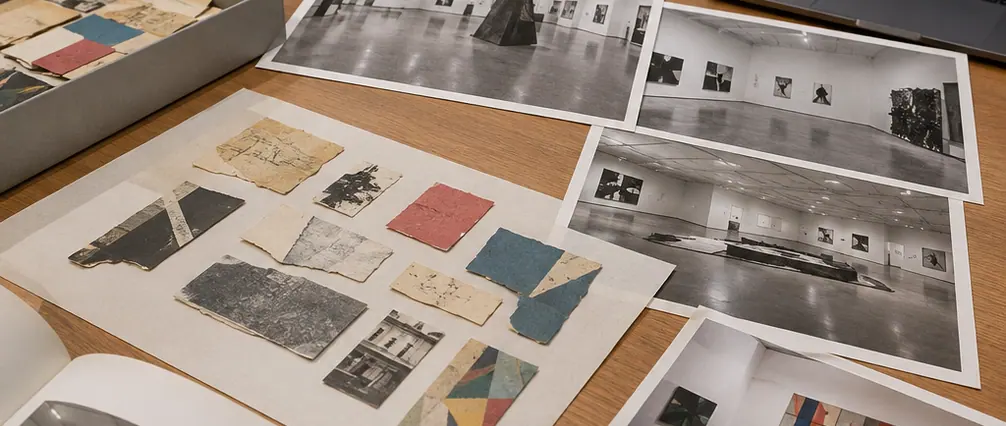
Resolving these discrepancies requires a strict comparative methodology that pairs day-of-show paper with 35mm installation slides, contact sheets, and local press reviews:
- Compare the Billed Lineup Against the Floor Sheet: Lay the advance postcard mailer beside the photocopied checklist to identify dropped pieces, unbilled collaborators, or retitled works immediately.
- Map Contact Sheets to the Numbered Sequence: Align the sequential frames of a 35mm contact sheet with the numbered entry order of the gallery checklist. Photographers documenting a show typically walk the floor in a continuous path; recurring architectural details in the background—such as support columns, electrical conduits, or window casements—anchor the spatial direction of the room.
- Verify Apparatus Through Local Press Notices: Cross-check visual ambiguities against contemporaneous newspaper clippings. Reviewers writing days after the opening frequently describe the sensory sensation of navigating a darkened corridor or note the physical clutter of specific playback gear.
An unlabelled installation photograph earns a proven attribution, at least for fixed sculptural or video setups, only when its visible technical apparatus matches the material description on the day-of-show checklist and aligns with physical descriptions in independent press notices. One structural boundary dictates what the archivist must seek next: paper-and-photo triangulation cannot establish the sequence, sonic modulation, or spatial movement of improvising performers or unscripted sound works unless paired with continuous time-stamped audio or video recordings from the floor.
Organizing and Digitizing Fragile Paper in Artist-Run Spaces
Grassroots venues and experimental music spaces rarely construct their historical legacy on archival rag paper. Their history survives on acidic photocopy bond, high-lignin newsprint inserts, and fugitive thermal-printed receipts stuffed into desk drawers. Stabilizing these volatile substrates demands an immediate dual workflow combining chemical sorting with high-resolution digital capture.
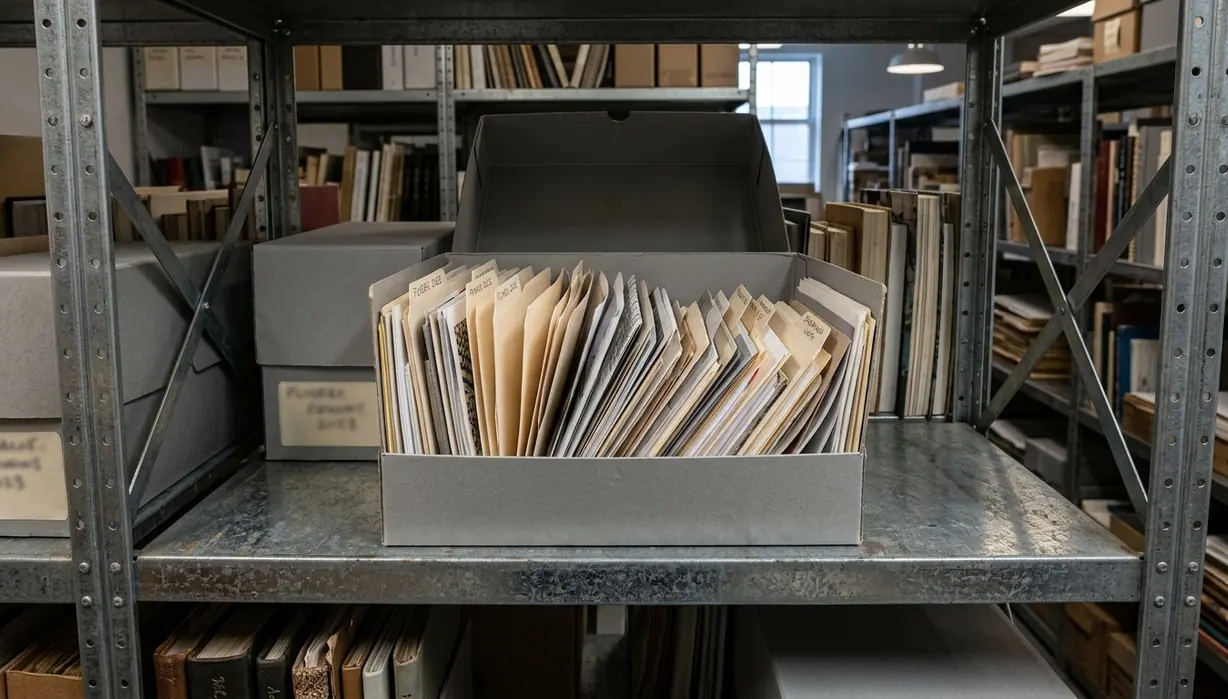
Physical stabilization begins by sorting loose printed matter according to paper chemistry and removing all rusting metal staples, paperclips, and degrading rubber bands with a micro-spatula. Acidic photocopy bond and newsprint inserts require storage inside alkaline-buffered file folders laid flat within acid-free clamshell boxes; the calcium carbonate buffer neutralizes migrating acids and slows brittle yellowing. Fugitive thermal paper—commonly found in early fax press releases and equipment rental receipts—demands the exact opposite chemical environment.
Thermal Paper Volatility
Never place thermal-printed receipts or early fax sheets inside alkaline-buffered folders. Exposure to alkaline buffers, heat, or UV light triggers a chemical reaction that turns thermal coatings completely black; house these fragments in dark, unbuffered, pH-neutral enclosures and scan them immediately.
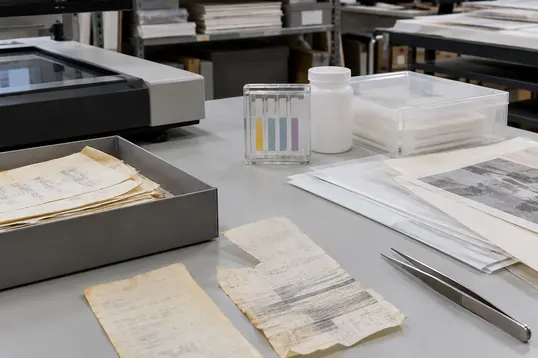
Before any physical folder goes onto a storage shelf, every fragile fragment must pass across a flatbed scanner. Digitization standards for gallery ephemera require capturing both the recto and verso of every checklist, mailer, and handout at 600 DPI in uncompressed 24-bit color TIFF format. Scanning the reverse side is non-negotiable. The blank backs of gallery sheets routinely hide faint pencil annotations, audio routing sketches, folding creases that prove how a guide was carried, and postal marks that establish regional mailing networks.
Independent art spaces should stop treating archival preservation as a retrospective rescue project conducted decades after a venue closes. Institute a mandatory floor intake protocol today: before any current exhibition or sound event strikes its equipment, file two clean physical copies and one uncompressed 600 DPI raw digital scan of every checklist, wall label set, and mailer into permanent archival storage.